Investment Breakdown: Palm Springs vs. La Quinta—Which City Offers the Best ROI for Luxury Vacation Rentals?

Investment Breakdown: Palm Springs vs. La Quinta—Which City Offers the Best ROI for Luxury Vacation Rentals?

“If you buy a rental in the wrong zone in 2025, you aren’t buying an asset. You’re buying a very expensive guest house that only your mother-in-law can visit.”

I tell this to investors every week. The Coachella Valley real estate market has shifted. It’s no longer just about square footage or pool size; it’s about jurisdiction.

Palm Springs and La Quinta are the two heavyweights of our desert. Both command premium nightly rates. Both attract high-net-worth travelers. But they operate like two different countries with two distinct financial engines.

Palm Springs is the “Weekender”—high turnover, festival spikes, and younger money. La Quinta is the “Resort”—stable, golf-centric, and family-oriented.

Choosing between them isn’t a matter of preference. It’s a matter of math.

Here is the strategic breakdown of where to park your capital this year.

ROI by Rental Profile

The first mistake rookie investors make is assuming all rental income looks the same. It doesn’t. The velocity of money differs wildly between these two cities.

Palm Springs: Maximizing Weekender & Festival Revenue

Palm Springs is an adrenaline economy. The revenue model here relies on frequency and spikes.

You are buying here for the three-day turnover. The typical guest is a couple from Los Angeles or a group of friends flying in for a design tour, Modernism Week, or Coachella. They want proximity to downtown. They want “Instagrammable” Mid-Century Modern architecture.

The Revenue Pattern:

  • Thursday – Sunday: You command premium rates ($800 – $2,500/night depending on luxury tier).
  • The Festival Premium: During Coachella and Stagecoach, a prime Palm Springs estate can cover three months of carrying costs in two weekends.
  • The “Junior” Strategy: Because of strict contract limits (more on that below), some investors are shifting to the “Junior Permit” model—renting only during peak weeks (6 contracts/year) and using the property personally the rest of the time. This yields a lower gross ROI but significantly reduces wear and tear.

The Ideal Asset: A 1950s Alexander or Wexler home in neighborhoods like The Movie Colony or Vista Las Palmas. Renovated, walled, and gated.

La Quinta: Maximizing Golf & Family Longer Stays

La Quinta plays the long game. This is not about turnover; it’s about stability.

The renter profile here shifts dramatically. You are targeting multi-generational families, snowbirds escaping Canadian winters, and serious golfers. These guests don’t want to be near a nightclub; they want to be on the 14th fairway of a Jack Nicklaus course.

The Revenue Pattern:

  • Seasonal Bulk: La Quinta properties often book for 30+ days at a time during “The Season” (January – April).
  • Operational Efficiency: One check-in per month means significantly lower cleaning fees, less administrative headache, and less wear on the furniture.
  • Summer Resilience: While Palm Springs slows down in July, large La Quinta estates with massive pools often attract local families or drive-market guests looking for a private resort compound, provided the HOA allows it.

The Ideal Asset: A 4,000 sq. ft. contemporary estate in PGA West or near the SilverRock resort development.

Regulatory Risk and Operating Costs

This is where the deal lives or dies. You can have the most beautiful home in the desert, but if you don’t have the permit, your ROI is zero.

Comparison of STR Permit Difficulty and Fees

Palm Springs: The “Scarcity” Model

Palm Springs regulates through scarcity.

  • The Neighborhood Cap: The city caps Vacation Rental Certificates at 20% of total dwellings in any specific neighborhood organization.
  • The Waitlist: Many prime neighborhoods (Racquet Club, Tahquitz River Estates) are already at capacity. If you buy there, you go on a waitlist. You cannot rent short-term until a spot opens up.
  • The Contract Limit: Regular permits are limited to 26 contracts per year. This forces you to prioritize high-dollar weekends. You cannot nickel-and-dime your way to profit here; every booking must count.

Investor Note: We always check the specific neighborhood density before we write an offer. Never assume a permit is available.

La Quinta: The “Zone” Model

La Quinta regulates through geography.

  • The Ban: There is a permanent ban on new Short-Term Vacation Rental (STVR) permits in traditional residential neighborhoods (Non-Exempt Areas).
  • The Exemption: This is the golden ticket. Properties in “Exempt Areas” (specific Tourist Commercial zones and specific developments like PGA West, SilverRock, and others) are allowed to operate STVRs.
  • Certainty: If you buy in an Exempt Area, you generally don’t face a waitlist. You just apply, pay the fees, and operate. This offers higher certainty for investors than the shifting caps in Palm Springs.

HOA Dues vs. Utility Costs

Palm Springs (Fee Light, Utility Heavy)

Most Palm Springs single-family homes are on fee simple land with no HOA.

  • Pro: You control your exterior. No board telling you what color to paint your door.
  • Con: You pay 100% of the pool maintenance, landscaping, and security.
  • Hidden Cost: Heating a pool in January for a guest who leaves the cover off can cost $800-$1,000 a month in gas.
La Quinta (Fee Heavy, Utility Moderate) La Quinta is the land of the HOA.
  • Pro: The HOA often covers common area landscaping, 24-hour guard gates (huge selling point for high-end renters), and sometimes cable/internet.
  • Con: Monthly dues in premier communities (The Hideaway, The Madison, PGA West) can range from $600 to over $1,500.
  • Risk: HOAs can change their rental rules. You need to review the CC&Rs specifically to ensure the HOA hasn’t imposed a 30-day minimum, even if the city allows shorter stays.

Architectural and Amenity Demand

What makes a renter click “Book Now” at $1,500 a night? It differs by zip code.

The Must-Have Amenities in Palm Springs

In Palm Springs, you are selling

Style.

  • The “Look”: If it doesn’t look like a Slim Aarons photo, it won’t rent at top tier. Mid-Century Modern furniture, art-forward interiors, and color pops are mandatory.
  • The Fire Pit: The quintessential Palm Springs evening involves cocktails around a fire pit with mountain views.
  • Walkability: Properties within walking distance of Palm Canyon Drive command a premium because the guests tend to be younger and want to dine out without driving.

The Must-Have Amenities in La Quinta

In La Quinta, you are selling Scale.

  • Bedroom Count: The money in La Quinta is in the 4, 5, or 6-bedroom homes. You are hosting two or three families together.
  • The View: A view of the fairway or the Santa Rosa mountains is non-negotiable for luxury pricing.
  • Resort Pools: A simple rectangle pool doesn’t cut it. Guests expect spillover spas, tanning shelves (Baja shelves), and outdoor kitchens with high-end grills.
  • En-Suite Bathrooms: Since you are hosting multiple couples, having a bathroom for every bedroom is a massive value driver.

Structure Your Strategic Acquisition

So, which city fits your portfolio?

Choose Palm Springs if:

  • You want an asset that appreciates on architectural pedigree.
  • You plan to use the home frequently for your own weekend getaways.
  • You are comfortable with high-turnover management and strict “neighbor-friendly” noise rules.

Choose La Quinta if:

  • You want a “set it and forget it” cash flow model with longer stays.
  • You prefer the security of gated communities.
  • You want to avoid the “waitlist anxiety” of Palm Springs permits (provided you buy in an Exempt Zone).

This market is nuanced. A street-by-street analysis is the only way to ensure your numbers work. We are seeing incredible opportunities in specific pockets of La Quinta where prices have softened slightly, creating a perfect entry point for investors ready to act.

Next Steps

Do not guess on the regulations. Let us run the numbers for you.

Contact us today to request a customized ROI Pro Forma. We will pull the real-time rental data, check the specific address against city caps or HOA restrictions, and give you a clear picture of your potential yield.

The Collector’s Guide: Investing in Architectural History During Palm Springs Modernism Week

The Collector's Guide: Investing in Architectural History During Palm Springs Modernism Week

“Architecture should speak of its time and place, but yearn for timelessness.” — Frank Gehry.

In the Coachella Valley, this sentiment is not just philosophy; it is a tangible asset class. As Palm Springs Modernism Week approaches, the eyes of the global design community turn toward our desert enclave. Yet, for the astute investor and the architectural connoisseur, this event signifies more than just open houses and cocktail parties. It represents a prime window to evaluate Palm Springs Modernism Week Real Estate not merely as housing, but as collectible art.

At Engel & Völkers, we see a shift in how high-net-worth individuals approach these properties. We are no longer just selling square footage. We are transferring stewardship of history. When you acquire a Wexler or a Neutra, you secure a position in a finite legacy. This guide details how to navigate the market for Mid-Century Modern Homes for Sale Palm Springs with the precision of a curator.

The MCM Investment Rationale

A Basquiat canvas does not fluctuate based on the price of paint. Similarly, true architectural homes in Palm Springs have decoupled from standard market comparables. They operate on a different valuation tier driven by provenance, pedigree, and integrity.

We advise our clients to view these structures through the lens of scarcity. There is a finite supply of homes authored by the mid-century masters. Unlike contemporary builds, we cannot simply construct more 1958 Alexander Originals. This fixed supply, paired with a global demand that accelerates during Modernism Week, creates a powerful value proposition for the educated buyer.

Key Architectural Signatures

To invest wisely, you must identify the hands that shaped the desert. While many homes bear the “mid-century” label, Collecting Architectural Homes requires distinguishing between a generic renovation and a masterwork. We focus our acquisition strategies on the “Holy Trinity” of desert modernism:

  • Richard Neutra: Look for the dissolution of indoor-outdoor boundaries. His “spider leg” outriggers and silver-painted window frames are not just stylistic choices; they are trademarks of a philosophy that integrated the stark desert environment with domestic life.
  • Donald Wexler: A pioneer of steel construction. A Wexler steel home is the ultimate prize for many collectors due to its rarity and structural resilience. The clean lines and folded plate roofs are unmistakable.
  • E. Stewart Williams: He brought a warmth to modernism, often utilizing natural materials like wood and stone to anchor the home to the site. His structures feel grown from the desert floor rather than placed upon it.

The Scarcity Principle

The market rewards purity. A property that retains its original footprint, post-and-beam construction, and clerestory windows commands a premium over one that has been aggressively altered.

We often see a sharp divide in valuation between “restored” and “preserved” homes. A restored home returns a modified structure to its original glory, often requiring significant capital but resulting in a high-value asset. A preserved home, however, is a time capsule—a structure that has never been compromised. These uncompromised originals are the unicorns of the market. They are incredibly rare and offer the highest potential for appreciation because they offer an authentic narrative that cannot be replicated.

Where to Find the Best MCM Homes Today

During Modernism Week, inventory moves quickly. Knowing where to look is half the battle. We direct our clients to specific enclaves where architectural integrity remains protected and celebrated.

Vista Las Palmas

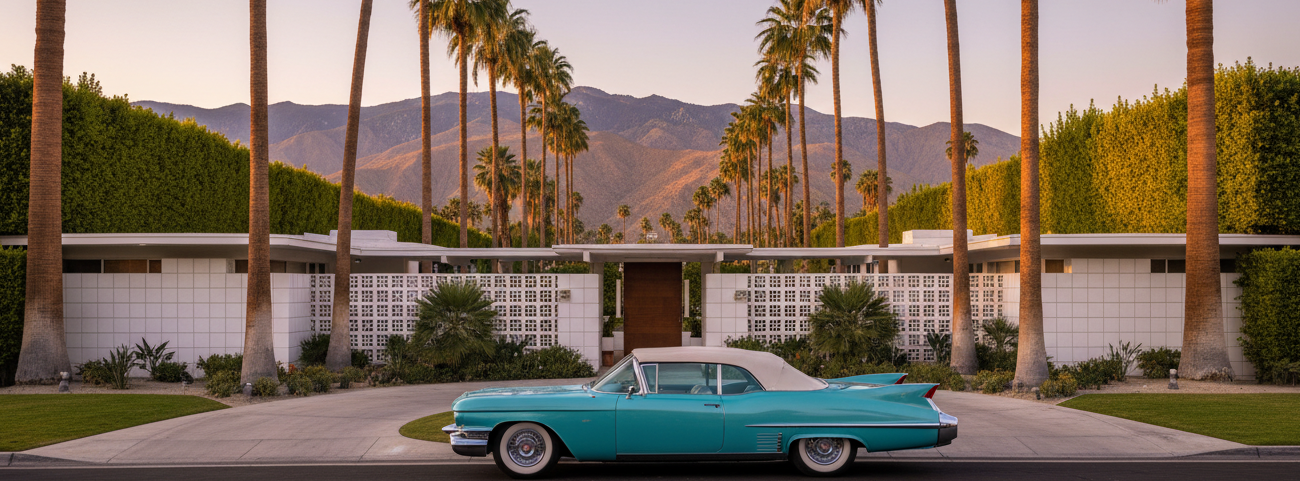
If you seek the “Beverly Hills of Palm Springs,” this is your destination. Historically home to the Hollywood elite—from Marilyn Monroe to Dean Martin—Vista Las Palmas offers some of the most dramatic rooflines in the valley. The neighborhood is defined by its wide streets and the high concentration of Alexander Construction Company homes designed by Palmer & Krisel.

Here, the quintessential “butterfly roof” is more than a design element; it is a status symbol. The appreciation in this neighborhood has been consistent, driven by the sheer density of Class 1 Historic Sites. When we list a property here, we are marketing a lifestyle of uncompromising luxury.

Sunmor and Racquet Club Estates

For the collector who values the specific aesthetic of the Alexander and Meiselman homes, these neighborhoods are ground zero.

Sunmor is a hidden gem. It sits centrally located yet maintains a serene, wind-free atmosphere that is rare in the valley. The homes here often feature the distinct breeze-block walls and breezeways that define the era. It is an area where we see tremendous upside potential for buyers willing to perform sensitive restorations.

Racquet Club Estates, famously associated with the Racquet Club resort, offers the classic post-and-beam construction that purists adore. These homes were originally built as vacation getaways, meaning they were designed for leisure and flow. Today, they stand as perfect entry points for serious collectors starting their portfolio.

The Due Diligence of a Collector’s Property

Acquiring a vintage home differs vastly from buying new construction. The very features that drive value—original materials, flat roofs, single-pane glass—also present unique ownership challenges. We guide our clients through a rigorous due diligence process to ensure the asset is sound.

Navigating Historic District Regulations

Owning a piece of history comes with responsibility. Many of the most desirable MCM homes fall under Historic District designations or carry a Class 1 Historic Site status.

This is a double-edged sword. On one side, it guarantees that your neighbors cannot demolish their homes to build McMansions, protecting your property value. On the other, it restricts what you can do to the exterior of your own home. You cannot simply replace windows or change paint colors without approval. We help you navigate the Mills Act—a critical tax incentive that offers significant property tax reductions in exchange for preserving the home’s historical appearance. It is a powerful tool for ROI, but it requires expert navigation.

Assessing Original Systems

Authenticity is beautiful, but 1950s infrastructure is not. When we evaluate a “preserved” home, we look past the terrazzo floors and globe pendant lights to the bones of the structure.

  • Plumbing: Many original homes still have galvanized steel pipes, which have a finite lifespan. We check for proactive repiping.
  • Electrical: The original panels were not designed for modern load demands—EV chargers, smart home systems, and high-efficiency HVAC. A 200-amp panel upgrade is often a necessary capital improvement.
  • Insulation: The iconic flat roofs often lack insulation, making the home energy-inefficient. We identify properties where modern foam roofing systems have been applied to improve efficiency without ruining the architectural profile.

Structure Your Strategic Acquisition

Modernism Week is not just a celebration; it is a catalyst for the real estate market. The most desirable properties often transact quietly, sometimes before they ever reach the public MLS.

If you are serious about securing a piece of Palm Springs history, do not wait for the open houses. We have access to off-market architectural properties and can arrange private viewings tailored to your specific acquisition criteria.

Ready to curate your collection?

Contact us today to request a private portfolio of architecturally significant homes currently available for purchase.

The A-List: Top Interior Designers for Palm Springs Luxury Homes (From Desert Modern to Hollywood Glam)

The A-List: Top Interior Designers for Palm Springs Luxury Homes (From Desert Modern to Hollywood Glam)

“God is in the details.” Mies van der Rohe said it best. When you acquire a property in the Coachella Valley, you aren’t just buying square footage. You are buying light. You are acquiring a relationship with the San Jacinto Mountains. The structure is merely the canvas.

Real luxury in the desert requires more than a credit card and a catalog. It demands a specialized eye.

We see it constantly. A client purchases a stunning architectural gem in a historic neighborhood, only to fill it with furniture that fights the architecture. Or they buy a new build and treat it like a generic condo in Miami. The result is a home that feels disjointed. It lacks soul.

To maximize your asset’s value and your personal enjoyment, you need talent that understands the specific vernacular of the desert. We have curated a list of the finest design minds operating in the Valley today. These are the professionals we trust.

Designers Specializing in Mid-Century Modern Restoration

The Palm Springs aesthetic is world-renowned. But there is a fine line between authentic restoration and “kitsch.” You want a home that respects its 1959 roots but functions with 2025 technology. It shouldn’t look like a museum set. It must live and breathe.

The Preservationists: Mastering Old Las Palmas

When you secure a property in a neighborhood as storied as Old Las Palmas, you become a steward of history. You might own a Wexler or an Alexander. The renovation process here is rigorous. It involves strict historic preservation codes.

H3K Design stands out in this arena. They don’t just “decorate.” They resuscitate.

Their team understands the structural honesty of Mid-Century Modernism. They know how to open up a galley kitchen without destroying the load-bearing integrity of a post-and-beam roof. They source terrazzo that matches the original aggregate. They find hardware that feels substantial, not cheap.

If you have purchased a restoration project, you need a team that speaks the language of the local preservation board. We have seen H3K navigate complex permits while delivering interiors that feel effortlessly cool. They respect the provenance of the home.

The Technicolor Visionaries: Bold Color and Signature Style

Palm Springs is one of the few places on earth where you can paint a front door pink and it increases the property value. But color is dangerous. In the wrong hands, it looks juvenile. In the right hands, it looks like high fashion.

Christopher Kennedy defines this category. He does not do beige.

Kennedy’s work captures the optimism of the mid-century era but updates it for a modern luxury lifestyle. Think Slim Aarons come to life. He understands that in the harsh desert light, colors read differently. A blue that looks soothing in Seattle will look washed out here. A yellow that looks cheerful in New York might be blinding in the Coachella Valley sun.

His approach suits clients who want their home to make a statement. It is about glamour. It is about entertaining. If your goal is to have the most photographed home during Modernism Week, this is the direction to take.

Designers Specializing in Contemporary/New Luxury

Not every buyer wants a history lesson. Many of our clients prefer the clean lines and massive scale of new construction. This requires a completely different design discipline.

The New Desert Minimalists: Rancho Mirage & La Quinta

Move east to Rancho Mirage or the exclusive enclaves of La Quinta, and the architecture shifts. The homes are larger. The ceilings soar to fourteen feet. The walls are made of disappearing glass.

Furnishing these spaces is an exercise in scale. Regular furniture looks like dollhouse miniatures in a 6,000-square-foot great room.

Barclay Butera brings a sophisticated, transnational vibe that works exceptionally well in these environments. While known for a Newport Beach coastal aesthetic, his desert projects are masterclasses in texture. He uses linen, heavy weaves, and dark woods to ground these airy spaces.

In new luxury builds, the danger is sterility. The house can feel like an Apple store. A designer like Butera introduces warmth without clutter. He understands that in a country club setting, the view of the fairway is the art. The interior must complement that view, not compete with it.

The Eco-Modernists: Indoor-Outdoor Continuity

The greatest asset of your desert home is the ability to live outside six months of the year. The boundary between the living room and the pool deck should be invisible.

Designers like Angela Wells specialize in this continuity. This style is not about placing “patio furniture” outside. It is about selecting weather-resistant materials that look like interior velvet or leather, allowing the design scheme to flow right through the open sliders.

Sustainability plays a massive role here. We are seeing a surge in demand for materials that don’t off-gas, locally sourced stone, and energy-efficient window treatments that manage heat gain without blocking the view. This is critical in areas like Indian Wells, where buyers are increasingly conscious of their environmental footprint.

Working with an Out-of-Area Designer vs. Local Expertise

We often hear clients say, “I love my designer from Chicago. I’ll just fly them in.”

Be careful.

Talent travels. Practical knowledge does not. A designer who has never worked in the Low Desert does not understand what happens to a south-facing sofa in July.

Local Knowledge of Suppliers and Contractors

Logistics in the Coachella Valley are unique. The best tradespeople are booked months in advance. A local designer has these vendors on speed dial. They know which millworker can actually build a custom walnut vanity in four weeks. They know which tile installer will show up on time.

An out-of-area designer brings no leverage. If a problem arises, they are a flight away. A local designer is on-site, inspecting the grout lines and ensuring the drapery tracks are recessed correctly before the drywall goes up. In luxury real estate, time is your most expensive commodity. Local connections save time.

The Importance of Climate-Appropriate Materials

The sun here is aggressive. It destroys standard fabrics. It warps certain woods. It melts low-grade adhesives.

We have seen beautiful silk rugs disintegrate in two seasons because a designer from the East Coast didn’t account for UV exposure. Local experts know which performance fabrics stand up to the elements while still feeling luxurious to the touch. They know that you cannot use certain lacquers on exterior doors because the heat will crack them.

Hiring locally isn’t just about supporting the community. It is an insurance policy for your interior.

Next Steps: Curate Your Lifestyle

Your home is the backdrop for your life in the desert. It should reflect your success and your taste. Whether you are closing on a mid-century classic in Palm Springs or a custom estate in Palm Desert, the right design team makes the difference between a house and a masterpiece.

We hold the keys to more than just the properties. We hold the relationships. If you need a personal introduction to any of the designers mentioned above, or if you want to discuss which aesthetic will maximize your property’s resale value, reach out to us.

Contact Engel & Völkers Palm Springs today to discuss your acquisition and renovation strategy.

Beyond the Pool: Exploring Luxury Homes with Private Tennis Courts, Wine Cellars, and Other Exclusive Amenities in Palm Springs

Beyond the Pool: Exploring Luxury Homes with Private Tennis Courts, Wine Cellars, and Other Exclusive Amenities in Palm Springs

“Luxury must be comfortable, otherwise it is not luxury.” — Coco Chanel.

In the Coachella Valley, comfort has evolved. It’s no longer just about square footage or a south-facing pool. Today, the definition of high-end real estate is driven by hyper-specific, integrated amenities that facilitate a lifestyle of absolute convenience and private indulgence.

We see a shift in what our most discerning clients demand. They don’t just want a home; they want a private resort. They want infrastructure that supports their passions without leaving the front gate. Whether it’s a clay surface tennis court that rivals Indian Wells or a wine cellar capable of protecting a Bordeaux collection from the desert heat, these features are the new currency of exclusivity.

Finding these properties, however, is not a simple task. They are rare. They are expensive to build. And they move quickly when they hit the market.

The Wellness & Entertainment Wing

The modern luxury buyer views their home as a sanctuary for health and social connection. Consequently, we are seeing a surge in demand for dedicated wellness and entertainment wings that go far beyond a simple gym or media room.

Private Tennis and Pickleball Courts

Finding a property with a regulation-size tennis court in the desert is a challenge of geometry. Standard lots simply cannot accommodate the 7,200 square feet required for a single court, let alone the setback requirements. This is why Luxury Homes with Tennis Court Rancho Mirage and similar estates in La Quinta command such a premium. You are paying for the double-lot rarity.

Recently, the demand has shifted toward pickleball, but the prestige of a sunken tennis court remains unmatched. For the true enthusiast, surface material matters. In our climate, post-tension concrete is standard to resist heat cracking, but we occasionally see Har-Tru clay courts in ultra-exclusive enclaves. These require meticulous daily maintenance—watering and rolling—which implies a full-time staff.

If you are seeking a community where this lifestyle is built into the very fabric of the neighborhood, look no further than Rancho La Quinta. Here, the integration of sport and living is seamless, offering a level of access that is difficult to replicate in a standalone estate.

Screening Rooms and Dedicated Home Theaters

A large television in a living room is not a home theater. When we list a property with a ‘Private Home Theater Desert’ amenity, we refer to a space engineered for acoustic perfection.

True screening rooms in the Coachella Valley are often built as “floating rooms.” The walls are isolated from the main structure to prevent sound transmission. This is critical in modern architectural styles where hard surfaces—glass, steel, stone—are prevalent. Without sound dampening, audio bounces uncontrollably.

We look for tiered seating with haptic feedback, 4K or 8K projection systems, and Kaleidescape servers that store uncompressed films. This is not about watching a movie; it is about replicating the cinema experience without the crowd. The value here lies in the technology rack, often hidden in a climate-controlled closet, which can cost upwards of $200,000 alone.

The Connoisseur’s Amenities

For the collector and the culinarian, the home must serve as both a vault and a stage. These spaces are designed to preserve investments and facilitate elite-level hospitality.

Wine Cellars and Tasting Rooms

The desert environment is the natural enemy of fine wine. Extreme heat and low humidity can destroy a vintage in hours. Therefore, searching for ‘Homes for Sale with Wine Cellar Palm Springs’ requires a critical eye for engineering, not just aesthetics.

A proper desert wine cellar is a feat of insulation. It requires a distinct vapor barrier wrapping the entire room—floor, walls, and ceiling—to maintain humidity levels between 50% and 70%. Without this, corks dry out and wine oxidizes. We see many “wine closets” that are merely glass boxes; these are decorative. A serious collector needs a dedicated cooling unit (often a split system) that runs independently of the home’s HVAC.

The most impressive cellars we tour are often subterranean or centrally located within the home’s thermal mass to reduce energy load. They feature redwood or mahogany racking (which resists rot and odors) and include a tasting area where decanting becomes a ritual.

Professional-Grade Chef’s Kitchens and Catering Spaces

The “open concept” kitchen is for family; the “scullery” is for the serious work. In the highest tier of luxury real estate, we see a return to the dual-kitchen layout.

The show kitchen features quartzite islands and designer lighting. Hidden behind it is the working kitchen, or scullery. This is where the catering team operates during a gala. These spaces are equipped with high-BTU Wolf ranges, commercial-grade ventilation systems that can cycle the air in the room in minutes, and walk-in refrigeration.

This separation allows for seamless entertaining. Guests enjoy the hors d’oeuvres and conversation without witnessing the chaotic preparation or the cleanup. It elevates the hosting experience from “dinner party” to “event.”

The Ultimate Outdoor Living Experience

In the Coachella Valley, indoor-outdoor living is a cliché. We look for outdoor spaces that function as fully independent living zones, usable year-round despite the temperature swings.

Outdoor Kitchens, Pizza Ovens, and Custom BBQs

An outdoor kitchen in Palm Springs must withstand intense UV exposure and high winds. Standard stainless steel often isn’t enough; we look for marine-grade 316 stainless steel or masonry structures that won’t warp or discolor.

The current trend is the wood-fired pizza oven. These heavy masonry units retain heat for hours and act as a gathering point. But the real luxury is in the infrastructure: gas lines run for high-pressure wok burners, dedicated ice makers that produce clear ice, and Kegerators for craft beer on tap.

Wind management is also key. The best outdoor kitchens are positioned strategically or shielded by glass windscreens to ensure the flame on the grill never flickers, even during a Santa Ana wind event.

Private Putting Greens and Water Features

Water features in the desert are a declaration of abundance. But beyond the aesthetic, they serve a cooling function, lowering the ambient temperature of a patio by several degrees.

For the golfer, a private putting green is the ultimate backyard amenity. However, maintaining real bentgrass in the desert summer is a full-time job requiring massive water usage. This is why we advocate for high-end synthetic turf options. The technology has improved drastically; these greens now roll true, accept chip shots realistically, and require zero water.

We often see these greens integrated with sand traps and chipping pads, allowing you to practice your short game in privacy before heading out to the club. It’s about having the tools to perfect your craft at your fingertips.

Structure Your Strategic Acquisition

Properties with these specific, high-value amenities do not sit on the market. They are often traded quietly or snapped up by buyers who monitor specific criteria daily. You cannot rely on broad portal searches to find a home with a climate-controlled wine bunker or a regulation tennis court.

If you are ready to secure a home that matches your specific lifestyle requirements, we need to talk. We have access to the inventory that fits these exacting standards.

Contact Engel & Völkers Palm Springs today. Let us curate a viewing of the valley’s most exclusive, amenity-rich estates for you.

Buying Your Desert Home Remotely: The Seamless Guide to Acquiring Luxury Real Estate in Palm Springs Sight Unseen

Buying Your Desert Home Remotely: The Seamless Guide to Acquiring Luxury Real Estate in Palm Springs Sight Unseen

“Time is the only asset you cannot buy back.” This sentiment drives the modern luxury market. For high-net-worth individuals, flying across the continent for a preliminary viewing is often a logistical impossibility.

Here is the truth about the current market: A significant percentage of high-end transactions in the Coachella Valley now occur remotely. We see this daily. Clients from New York, Toronto, or San Francisco identify a property, tour it virtually, and close escrow without stepping foot on the driveway until they hold the keys.

Buying a multi-million dollar estate sight unseen requires more than just courage. It requires a precise, military-grade process and a broker who acts as your relentless advocate on the ground. We have refined the art of the ‘Remote Real Estate Purchase California.’

Phase 1: Virtual Discovery and Pre-Screening

The days of relying on grainy photos are over. When you are buying remotely, your agent acts as your eyes, ears, and nose. We do not just show you the view; we show you the flaws.

Hyper-Detailed Virtual Tours and Video Walkthroughs

Standard listing videos are designed to sell a dream. They use wide-angle lenses to make rooms look massive and color correction to make the grass look greener. These are marketing tools, not decision-making tools.

Our approach to ‘Virtual Home Buying Luxury’ is forensic.

The Live Tour:

We utilize high-definition video calls (FaceTime, Zoom, or WhatsApp) to walk you through the home in real-time. This is interactive. You tell us where to look. Want to see the brand of the range? We zoom in. Want to see the condition of the grout in the master shower? We get close. We open cabinets to check for water stains under the sink. We open the sliders to let you hear the ambient noise—or lack thereof.

The Recorded Walkthrough:

Connection drops happen. To ensure you miss nothing, we also record a raw, unedited 4K video walkthrough. We narrate this tour with brutal honesty. If the floorboards squeak, we step on them. If the paint is peeling on the south-facing wall due to sun exposure, we point it out. You receive a link to download this video so you can watch it on your largest screen, pausing and zooming at your leisure.

Neighborhood Scouting by the Broker

A house does not exist in a vacuum. In the Coachella Valley, the micro-climate and neighborhood nuance are everything.

You might find a stunning architectural home in Palm Springs, but is it in a wind tunnel? The North end of town experiences significantly higher wind speeds than the South end, particularly in the spring. A listing photo will not tell you that your pool furniture might end up in the neighbor’s yard. We will.

We drive the streets for you. We film the approach to the property.

  • Is the street lined with manicured hedges or deferred maintenance?
  • Is the property under a flight path?
  • How close is the nearest gate at a club like The Vintage or Bighorn?

We provide the local intelligence that data portals miss. We tell you if the “mountain view” is blocked by a proposed development next door.

Phase 2: Offer and Contract Management

Once we identify the property, speed is essential. The best homes in Indian Wells and Rancho Mirage still command attention. Our digital infrastructure allows you to strike quickly from anywhere in the world.

Digital Signatures and Secure Document Management

The days of faxing wet signatures are gone. We utilize industry-leading platforms like DocuSign and Authentisign.

These platforms are legally binding and encrypted. You can review, initial, and sign a 50-page purchase agreement on your iPad while sitting in a lounge at JFK or a café in Paris.

The Process:

  1. We draft the Residential Purchase Agreement based on our strategy session.
  2. We email you a secure link.
  3. You tap to sign.
  4. The offer is immediately delivered to the listing agent.

We organize every document—from the initial offer to the seller’s disclosures—in a secure, shared digital folder. You have 24/7 access to your transaction file. Nothing gets lost in an email chain.

The Art of Negotiation without Physical Presence

Some buyers worry that ‘Buying Home Sight Unseen Palm Springs’ weakens their negotiating position. The opposite is true—if your representation is strong.

We present your offer with a complete package that validates your strength as a buyer, regardless of your physical location. We verify your proof of funds or pre-approval with local lenders before submitting. We communicate to the seller that while you are remote, you are serious, qualified, and ready to perform.

Distance can actually be a leverage point. It removes the emotion from the room. We act as the buffer. We negotiate hard on price and terms based on data, not sentiment. We ensure the terms protect you, specifically regarding contingencies. We always advocate for a robust investigation contingency, giving you an “out” if the physical inspection reveals issues you are not comfortable with.

Phase 3: Inspections and Closing

This is the most critical phase for the remote buyer. This is where we verify that the asset matches the digital representation.

Coordinating Third-Party Inspections

In a standard transaction, the buyer often attends the home inspection. Since you are remote, we attend for you.

We do not rely on a single general inspector. Luxury homes are complex systems. We recommend a “team approach” to due diligence:

  • General Home Inspection: Checks structure, electrical, and plumbing.
  • HVAC Specialist: In the desert, air conditioning is a life-support system. We need a specialist to verify the tonnage and age of the compressors.
  • Pool Leak Detection: A cracked pool shell can cost tens of thousands to repair. We recommend bucket tests and pressure tests.
  • Sewer Scope: We run a camera down the main line to check for roots or breaks.

Once the reports are in, we do not just forward you a PDF. We get on a video call. We screen-share the report. We go through it line by line. We translate technical jargon into business decisions. If the roof needs $15,000 in work, we go back to the seller and negotiate a credit or repair. You stay in control.

Remote Escrow and Wire Transfer Security Protocols

California uses an “Escrow” system, which acts as a neutral third party holding funds and documents. You do not need to be here to close.

The Notary:

For the final closing documents that require a wet signature (like the grant deed), we coordinate a mobile notary. If you are in Chicago, the notary comes to your office. If you are in London, we arrange an appointment at the US Embassy or with an international notary.

Wire Fraud Safety:

Wire fraud is a global threat. We treat your capital with extreme caution.

  • Never trust wire instructions sent via unencrypted email.
  • We verify all instructions verbally with the Escrow officer.
  • We advise you to do the same before sending a deposit.

We track the wire. We confirm receipt. We confirm recording. The moment the county recorder stamps the deed, the house is yours.

Your Local Proxy

Buying luxury real estate remotely is not about skipping steps; it is about executing them with higher precision. You need a partner who understands the stakes.

At Engel & Völkers, we serve as your proxy. We treat your money and your potential home with the same scrutiny we would apply to our own. Whether you are looking for a mid-century renovation project or a turnkey estate in La Quinta, we bridge the distance.

Next Steps

Technology makes it possible. Experience makes it safe. If you are ready to explore the inventory in the Coachella Valley from the comfort of your current home, let us set up a virtual consultation.

Start your virtual property search today. Contact us to schedule a strategy call.

The Ultimate Seller’s Checklist: 7 Steps to Maximizing Value in the Current Palm Springs Luxury Market

The Ultimate Seller's Checklist: 7 Steps to Maximizing Value in the Current Palm Springs Luxury Market

“Time is the enemy of value.”

It is an old adage in our industry, but in the current Palm Springs market, it has never been more accurate. As of this quarter, we are seeing a clear bifurcation in the high-end sector. Turnkey, impeccably presented estates in Old Las Palmas and The Movie Colony are still commanding record prices per square foot. However, properties that launch with aspirational pricing or deferred maintenance are sitting. They accumulate days on market (DOM), and eventually, they suffer the stigma of a “stale listing.”

The difference between a record-breaking sale and a six-month hold often comes down to the work done before the listing hits the MLS. Buyers right now are selective. They are capital-conscious. They want the desert dream, but they demand it be effortless.

At Engel & Völkers, we guide our clients through a rigorous pre-market strategy. We don’t just put a sign in the yard; we manage an asset. If you are considering selling a luxury property in the Coachella Valley within the next 6 to 12 months, this is your strategic roadmap to commanding top dollar.

Phase 1: Preparation and Pricing

You only get one chance to make a first impression. The moment your listing goes live, the clock starts ticking. The goal here is to remove friction. We want a buyer to walk in and see a future, not a project.

The Pre-Listing Inspection Advantage

In a balanced or buyer-leaning market, information is power. Many sellers wait for the buyer to conduct inspections, hoping they won’t find the aging HVAC unit or the pool equipment nearing the end of its life. This is a mistake.

When a buyer uncovers these issues during escrow, they don’t just ask for a credit; they often lose emotional momentum. They start wondering, “What else is wrong?” This doubt kills deals or leads to aggressive re-trading.

I always recommend a pre-listing inspection for luxury estates. It allows us to control the narrative. If we find an issue, we fix it—or we disclose it immediately and price accordingly. Presenting a clean bill of health to a prospective buyer builds immense trust. It signals that you are a serious seller with a well-maintained asset. It removes the leverage buyers typically use to chip away at your price during the request for repairs.

Strategic Pricing: The Danger of “Testing” the Market

There is a temptation to “test” the market at a higher price, thinking, “We can always come down.” In the current climate, this is dangerous.

High-net-worth buyers are sophisticated. They have access to the same data we do. If a home is priced 10% over comparable sales in Palm Desert or Rancho Mirage, they won’t make a lowball offer—they simply won’t show up. They will wait.

When you eventually drop the price 30 days later, the excitement is gone. You are now chasing the market down rather than leading it.

We analyze the micro-data:

  • What is the absorption rate in your specific neighborhood?
  • How many competing luxury homes are currently active?
  • What is the list-to-sale ratio for homes with similar amenities?

Strategic pricing means positioning the home at the top of the justifiable range to generate urgency. We want to create a fear of missing out, not a “wait and see” attitude.

Phase 2: High-Impact Presentation

Once the mechanics are sound, we shift to aesthetics. Selling a luxury home in the desert is about selling a lifestyle. It is about capturing the specific allure of indoor-outdoor living that draws the world to our valley.

Luxury Staging: Curating the Desert Aesthetic

Staging is not just about furniture placement; it is about architectural interpretation. A mid-century modern home requires a different visual language than a Spanish estate in The Mesa.

We frequently see sellers rely on their own furniture. While your taste may be exquisite, personal items can distract. We need the buyer to envision their life in the space, not yours.

Effective staging in our market often involves:

  • Scale: Using substantial pieces that anchor large, open floor plans.
  • Palette: embracing organic textures and neutral tones that complement, rather than compete with, the desert views.
  • Flow: Arranging layouts that emphasize the seamless transition to the pool and outdoor entertainment areas.

We are selling the “Palm Springs chill.” If a room feels cluttered or confused, the buyer feels stress. We want them to feel relief.

Visual Storytelling

The first showing happens online. Period. If the digital presentation does not stop the scroll, the physical showing never happens.

Standard HDR photography is the bare minimum. For our elite listings, we employ a cinematic approach:

  • Twilight Photography: The “money shot” in the desert is often at dusk. We capture the property when the sky is a deep indigo, the pool lights are glowing, and the fire pit is roaring. This evokes an emotional response that daylight photos rarely achieve.
  • Drone Cinematography: We use aerial footage to show context. Buyers need to see the privacy of the lot, the proximity to the mountains, and the condition of the roof.
  • 3D Virtual Tours: International buyers may not be able to fly in immediately. A high-resolution Matterport tour allows them to walk the floor plan from London or New York.

We treat your property launch like a film premiere. Every asset must be perfect.

Phase 3: Targeted Marketing and Negotiation

You have a perfect product. Now, who needs to see it?

Global Exposure

Local MLS is insufficient for luxury assets. The buyer for your $4M estate might be in Los Angeles, but they are just as likely to be in Seattle, Toronto, or Berlin.

This is where the Engel & Völkers network becomes a tangible asset. We don’t just hope an international agent sees the listing; we actively syndicate your property to a global audience of high-net-worth individuals. We leverage our proprietary “Shop TV” in our storefronts worldwide and our exclusive publications.

We ensure your property appears where the wealth is. If we are selling a golf course estate in The Madison Club, we target specific demographics that value that privacy and exclusivity. It is surgical marketing, not a shotgun approach.

Negotiating Contingencies in a Buyer’s Market

When an offer comes in, the price is just one variable. In this market, terms matter immensely.

We are seeing buyers request extended contingencies, specific repairs, or financing pauses. As your representative, our job is to vet the buyer’s capability before we tie up your property.

  • Is the proof of funds current and liquid?
  • If there is a loan, is the lender reputable and responsive?
  • Are the contingencies reasonable for the age of the home?

We negotiate aggressively to tighten timelines. We want the buyer committed. If they want a 17-day inspection period, we push for 10. If they want a loan contingency, we ensure the appraisal is ordered immediately. We keep the momentum moving forward to ensure a successful close.

Structure Your Strategic Acquisition

Selling a luxury home in Palm Springs requires more than luck. It demands a deliberate, data-backed execution of the steps above. You need to prep the asset, price it with precision, present it beautifully, and market it globally.

If you are ready to discuss how we can position your property to outperform the market, let’s look at the numbers together.

Next Steps:

Contact us today to request a confidential, personalized Home Valuation and marketing consultation. Let’s maximize your return.

The Complete Financial Guide to Buying a Second Home in Palm Springs: Taxes, Financing, and Investment Strategy

The Complete Financial Guide to Buying a Second Home in Palm Springs: Taxes, Financing, and Investment Strategy

“Profit is made when you buy, not when you sell.”

This old real estate adage holds particularly true in the Coachella Valley. While the allure of Palm Springs lies in its architectural beauty and winter sun, the success of your purchase is determined by a rigorous understanding of the numbers before you sign the contract.

We often see a fundamental misunderstanding among buyers regarding the classification of their desert retreat. Is it a true second home? An investment property? Or a hybrid? The answer dictates everything from your interest rate to your tax bill.

This guide strips away the marketing fluff to expose the financial machinery behind owning a luxury desert residence.

Financing Your Desert Getaway

Cash offers are common in our market—often exceeding 40% of transactions in high-end communities like Rancho Mirage or Indian Wells. However, even high-net-worth clients frequently choose to finance to preserve liquidity for other ventures. If you plan to carry a mortgage, be prepared for a different set of rules than what you encountered with your primary residence.

Down Payment and Interest Rate Realities

Lenders view second homes as higher risk than primary residences. If financial hardship strikes, owners typically default on the vacation home first. Consequently, the days of 10% down payments for luxury second homes are largely behind us.

For a true “second home” (a property you occupy for part of the year and do not rent out full-time), most jumbo lenders now require a minimum of 20% to 25% down. If the purchase price exceeds $2 million, we often see requirements push to 30% or more depending on your debt-to-income ratio and liquidity.

Interest rates also carry a premium. You should anticipate a rate approximately 0.50% to 0.75% higher than current primary mortgage rates. This “pricing hit” is standard. If you intend to classify the property purely as an “investment” loan (relying on rental income to qualify), the rate premium can jump even higher, sometimes a full percentage point above standard rates, and down payment requirements often stiffen to 25-30% strictly.

Leveraging Home Equity (HELOCs) from a Primary Residence

A strategy we frequently recommend to cash-rich but liquidity-conscious buyers involves utilizing a Home Equity Line of Credit (HELOC) on their primary residence.

If you have significant equity in your main home, opening a HELOC allows you to make what appears to be a “cash offer” in the desert. You draw the funds to close the deal—strengthening your negotiating position against other buyers—and then have the flexibility to pay down the line at your own pace or refinance the desert property later when rates stabilize. This approach often bypasses the origination fees and slower underwriting timelines of a new jumbo mortgage on the purchase itself.

Tax Implications for Non-Primary Residents

The tax code favors the prepared. How you use your desert home determines whether it becomes a tax shelter or a tax burden.

Deductions for Second Homes (Mortgage Interest and Property Taxes)

If you treat the property strictly as a personal second residence (no renting), you can generally deduct mortgage interest on up to $750,000 of total mortgage debt (combined with your primary home).

However, many of our clients in California are already hitting the $10,000 cap on State and Local Tax (SALT) deductions. Since California property taxes are roughly 1.1% to 1.25% of the purchase price, a $2 million home in La Quinta generates an annual tax bill of roughly $24,000. Under current tax law, much of this may not be deductible if you have already maxed out your SALT limit with your primary residence.

Note: Always consult your CPA. We are real estate experts, not tax preparers.

The 14-Day Rule: Maximizing Personal Use vs. Rental Deductions

This is the most critical concept for owners who plan to dabble in vacation rentals. The IRS “Masters Rule” (Section 280A) creates a distinct line in the sand.

Scenario A: The Tax-Free Income Strategy

If you rent your home for 14 days or fewer per year, you do not have to report that income to the IRS. It is tax-free. You could rent your estate during Coachella or the BNP Paribas Open for $10,000 a night, pocket $140,000, and technically owe zero federal tax on that revenue. The trade-off? You cannot deduct any rental expenses (cleaning, management fees, maintenance).

Scenario B: The Rental Property Strategy

If you rent the home for 15 days or more, you must report all income. However, you can then deduct rental expenses (prorated based on the percentage of rental days vs. total days).

Here is the catch: If you personally use the home for more than 14 days per year (or 10% of total rental days, whichever is greater), the IRS classifies it as a “personal residence.” This limits your deductions strictly to rental income; you cannot claim a loss to offset other income.

To maximize tax benefits, many investors strictly limit their personal use to stay under that 14-day/10% threshold, allowing them to classify the property as a true business activity.

Annual Costs of Luxury Desert Ownership

The purchase price is just the entry fee. The operational costs in the desert are unique and can surprise the uninitiated.

HOA Fees, Utilities, and High-End Maintenance

HOA Fees: In communities like The Lakes or Ironwood, monthly dues can range from $900 to over $1,800. These often include cable, internet, trash, and immaculate grounds maintenance, but they are a fixed cost that never goes away. Conversely, fee-simple neighborhoods in South Palm Springs might have zero HOA, but you bear the full burden of landscaping and pool care.

Utilities: This is the shock factor. Summer air conditioning bills for a 3,000-square-foot home can easily run $600 to $900 per month in July and August. Solar is not just a “green” feature here; it is a financial necessity that adds tangible resale value.

Pool Heating: Everyone loves a heated pool in December, but gas heaters are thirsty. Heating a standard pool for a weekend can cost $300 to $500 in gas charges alone. We advise clients to install variable-speed pumps and high-efficiency heaters to mitigate this.

Insurance Requirements

Standard homeowners insurance covers fire and theft, but the desert has specific needs.

  1. Earthquake Insurance: This is almost always a separate policy. Premiums vary wildly based on the age of the home and proximity to fault lines, but deductibles are high (often 10-15% of replacement cost).
  2. Vacation Rental Riders: If you plan to Airbnb your property, your standard policy likely excludes commercial activity. You need a specialized “short-term rental” rider or a commercial policy. Operating without one exposes you to massive liability if a guest is injured.

Structure Your Strategic Acquisition

Buying a second home in the Coachella Valley is a significant financial move that requires a team of experts. You need a lender who understands the nuances of jumbo non-primary loans and a CPA who can navigate the 14-day rule to your advantage.

We work daily with a vetted network of local professionals who specialize in luxury desert portfolios.

Next Steps:

Do not guess at the numbers. Contact us today to review our list of preferred lenders and tax strategists, and let’s ensure your desert purchase is as financially sound as it is beautiful.

From Rat Pack to Today: The Enduring History and Modern Luxury of Old Las Palmas, Palm Springs

From Rat Pack to Today: The Enduring History and Modern Luxury of Old Las Palmas, Palm Springs

“If the walls could talk, the estates of Old Las Palmas would sing in the voice of Frank Sinatra and gossip in the whisper of Hedda Hopper.” In the high-stakes world of Coachella Valley real estate, few neighborhoods command the immediate reverence of Old Las Palmas. While other enclaves have their moments of trendiness, this grid of manicured streets between Palm Canyon Drive and the mountains remains the undisputed heavyweight champion of Palm Springs prestige. It is not merely a collection of homes; it is a living museum of Hollywood royalty. For the discerning buyer, Old Las Palmas offers something rarer than marble countertops or infinity pools: provenance. We know that in this market, history is an asset class of its own. When you acquire a property here, you are not just buying square footage. You are securing a chapter in the narrative of American glamour.

The Golden Age: Celebrity Residents and Architectural Legacy

In the 1950s, Palm Springs was the playground where the studio system went to unwind. Old Las Palmas was its VIP section. The neighborhood, roughly bounded by Alejo Road to the south and Stevens Road to the north, became the de facto dormitory for the world’s most famous faces. They came for the privacy. They stayed for the sunshine. They built estates that defined an era.

Key Figures and Their Houses

The roll call of past residents reads like the credits of a Golden Age blockbuster. Elizabeth Taylor and Mike Todd escaped here. Kirk Douglas held court in a tennis estate that became legendary for its gatherings. Liberace brought his signature flamboyance to the neighborhood, creating a residence as ornate and spectacular as his stage presence. Perhaps most famously, the “King of Cool” himself, Dean Martin, commissioned a home here. While Sinatra’s “Twin Palms” in the nearby Movie Colony often grabs headlines, Dean Martin’s Old Las Palmas retreat was the epitome of desert cool—low-slung, stylish, and built for entertaining. Today, this star power has not faded; it has merely changed hands. The estate once owned by Dinah Shore—a stunning architectural gem designed by Donald Wexler—is now the desert retreat of Leonardo DiCaprio. This seamless transition from the icons of yesterday to the titans of today underscores a critical market reality: Old Las Palmas does not depreciate in social currency.

The Architectural Evolution

The visual language of Old Las Palmas is distinct. Unlike neighborhoods defined by a single style, this area showcases the evolution of desert luxury. It began in the 1920s and 30s with Spanish Colonial Revival. You see this in the thick white stucco walls, red clay tile roofs, and heavy timber gates that guard sprawling haciendas. These homes were built to keep the heat out and the romance in. Then came the post-war boom. The aesthetic shifted. Architects like Donald Wexler, E. Stewart Williams, and Buff & Hensman introduced the clean lines of Mid-Century Modernism. They replaced small windows with walls of glass. They swapped tile roofs for flat planes that seemed to float against the San Jacinto mountains. The result is a streetscape of incredible diversity. A 1930s Spanish estate can sit comfortably next to a glass-and-steel modernist masterpiece. This variety protects property values. It ensures the neighborhood never feels cookie-cutter. Every gate opens to a unique world.


Why Old Las Palmas Remains Exclusive Today

History gets people to look, but lifestyle makes them buy. We often tell clients that Old Las Palmas commands a premium not just for who lived here, but for how you live here now. The fundamentals of the neighborhood are nearly impossible to replicate elsewhere in the valley.

Location and Walkability

In a region where driving is almost mandatory, Old Las Palmas offers a rare luxury: walkability. You are minutes from the Uptown Design District. The best coffee shops, the chicest boutiques, and the most celebrated restaurants on North Palm Canyon Drive are a short stroll away. Yet, once you retreat behind your hedges, the silence is absolute. You get the connectivity of an urban environment with the tranquility of a remote desert hideaway. This balance is the holy grail of Palm Springs real estate, and no other neighborhood strikes it quite like this one.

Lot Sizes and Mature Landscape

Land is the ultimate luxury. In newer developments, homes are often squeezed onto half-acre lots with minimal setbacks. Old Las Palmas is different. The estates here were plotted when land was abundant.

  1. Estate Lots: It is common to find properties ranging from half an acre to well over an acre.
  2. Privacy: Deep setbacks mean your home is not right on the street.
  3. The “Green Wall”: The landscaping is mature. We are talking about 80-year-old palm trees and ficus hedges that tower twenty feet high. You cannot buy that at a nursery. You have to wait decades for it.

This mature greenery creates a microclimate of shade and privacy that feels established and secure. When you swim in your pool, you are not visible to the neighbors. You are in your own private resort.


Investing in Legacy: Modernizing a Historic Home

Buying in Old Las Palmas often involves stewardship. Many of these homes are architecturally significant. The smartest money in the room knows that the goal is not to tear down, but to elevate. Navigating Permits and Historic Review Boards Because of its significance, Old Las Palmas has strict preservation guidelines. If you acquire a Class 1 Historic Site, you are buying a piece of protected history. This sounds daunting. It is actually an advantage. These regulations prevent your neighbor from building a monstrosity that blocks your mountain view. They ensure the character of the street remains intact. However, it does require a sophisticated approach to renovation. You need a team that understands the local Historic Site Preservation Board (HSPB). We guide our clients through this process regularly. We know which architects respect the pedigree of these homes and which contractors can deliver white-glove finishes that satisfy modern codes.

Maintaining Authenticity While

Integrating Modern Amenities The most successful renovations in Old Las Palmas follow a simple rule: Classic shell, modern engine.

  • The Shell: Keep the rooflines. Restore the original steel casement windows. Preserve the terrazzo floors if you can.
  • The Engine: Upgrade the HVAC. Install smart home technology. Modernize the plumbing. Open up the kitchen to the living space if the original floor plan is too compartmented.

Buyers today want the look of 1955 but the comfort of 2025. They want the Sinatra vibe, but they also want a Sub-Zero fridge and high-speed fiber internet. Properties that bridge this gap—respecting their roots while offering turnkey luxury—consistently set price records for the neighborhood.

Structure Your Strategic Acquisition

Old Las Palmas is not a volume market. Inventory is low. Turnover is rare. When a significant estate comes to market, it often trades quietly, sometimes before it even hits the MLS. If you are serious about securing a legacy property in Palm Springs’ most storied neighborhood, you need to be positioned correctly. You need access to off-market intelligence and a strategy that moves faster than the competition.

Ready to own a piece of history?

View exclusive listings in the Old Las Palmas neighborhood.

The 10 Most Exclusive Luxury Gated Communities in the Coachella Valley: A Comparative Ranking

The 10 Most Exclusive Luxury Gated Communities in the Coachella Valley: A Comparative Ranking

“Privacy is the ultimate luxury.” In the Coachella Valley, this isn’t just a saying; it’s the foundation of our real estate market.

When our clients approach Engel & Völkers looking for a desert estate, they rarely ask for just a “house.” They want a specific lifestyle. They want the heavy iron gates that swing open to reveal perfectly manicured fairways. They want the concierge who knows their drink order before they sit down. We understand this world because we live and work in it every day.

But not all gates are created equal.

We have ranked the top 10 gated communities in the valley based on exclusivity, amenities, and average price point. Whether you seek the ultra-private “billionaire’s row” or a vibrant, active club for your family, this list cuts through the noise to show you exactly where you belong.

The Ultra-Elite Tier (Rank 1-3)

These are the heavyweights. The membership rolls here read like a Who’s Who of global industry. If you value absolute discretion and amenities that rival the world’s finest resorts, start your search here.

1. The Madison Club (La Quinta)

The Vibe: Modern Opulence.

The Golf: Tom Fazio.

There is the Coachella Valley, and then there is The Madison Club. It sits at the top of our ranking for a reason. This isn’t just a country club; it is a sanctuary for those who require the highest level of security and service.

The discovery center here doesn’t just hand you a brochure. They hand you a lifestyle. We see buyers drawn here for the “comfort stations” on the golf course—essentially gourmet kitchens stocked with everything from wagyu sliders to tequila, free for members during their round. The homes are architectural marvels, often exceeding 10,000 square feet, blending seamless indoor-outdoor living with views that frankly, photos cannot do justice.

2. The Vintage Club (Indian Wells)

The Vibe: Timeless Prestige.

The Golf: Tom Fazio (Mountain & Desert Courses).

If The Madison Club is the new king, The Vintage Club is the established monarch. This community in Indian Wells has defined desert luxury for decades.

Privacy here is paramount. The club is nestled at the base of the mountain, creating a natural amphitheater of rock and green. When we tour clients through The Vintage, the first thing they notice is the service. It is impeccable. Invisible yet omnipresent. The 85,000-square-foot clubhouse was recently renovated, ensuring that while the history is deep, the amenities are cutting-edge. It’s quiet money. It’s old-school elegance.

3. Eldorado Country Club (Indian Wells)

The Vibe: Understated Power.

The Golf: Tom Fazio (Redesign).

Eldorado Country Club is where presidents play. It has a rich history dating back to 1957 and maintains a culture of intimacy that larger clubs cannot replicate. You won’t find flash here. You will find a deep sense of community among people who have nothing left to prove. The homes are often tucked away, revealing themselves only as you drive up the winding driveways. It is the definition of a hidden gem for the ultra-wealthy.

The Lifestyle-Focused Tier (Rank 4-7)

This tier offers an incredible balance. These communities are elite, certainly, but they often feature a more vibrant social scene, younger demographics, or architectural diversity that appeals to the modern buyer.

4. Bighorn Golf Club (Palm Desert)

The Vibe: Architectural Drama.

The Golf: Arthur Hills & Tom Fazio.

Bighorn Golf Club is a visual stunner. Located high above Palm Desert, the elevation gives you city light views that are unmatched.

What we love about Bighorn is the architecture. You aren’t limited to Spanish Colonial here. You will see sweeping, organic contemporary homes that look like they grew out of the rock face. The “Pour House” restaurant and the new clubhouse facilities are vibrant and social. It’s a place where people actually hang out. If you want a home that doubles as a piece of art, Bighorn is your canvas.

5. The Hideaway (La Quinta)

The Vibe: Young, Fun, Social.

The Golf: Clive Clark & Pete Dye.

The Hideaway changed the game in La Quinta. It brought a younger, cooler energy to the golf club scene. The bungalows are legendary, and the social calendar is packed.

We often recommend The Hideaway to clients who want the country club perks without the “stuffy” atmosphere. It’s widely known for its fun, relaxed environment where members linger long after the 18th hole. The homes are large, beautiful, and typically feature the classic Santa Barbara style that feels right at home in the desert sun.

6. Toscana Country Club (Indian Wells)

The Vibe: Italian Renaissance.

The Golf: Jack Nicklaus (South & North).

Walking into Toscana Country Club feels like stepping into a European village. The olive trees, the stone work, the fountains—it is incredibly transportive.

We appreciate Toscana for its “lock-and-leave” convenience combined with estate-level luxury. The sports club here is fantastic, with a massive focus on wellness, tennis, and pickleball. It fits the active buyer perfectly.

7. Rancho La Quinta

The Vibe: Active Family Resort.

The Golf: Robert Trent Jones Jr. & Jerry Pate.

Rancho La Quinta is the sweet spot for many of our clients. It offers a prestigious address and fantastic golf, but at a price point that allows for a second or third home without the stratospheric initiation fees of the top three.

The architecture here is distinct—think Early California with deep loggias and red tiles. It is incredibly friendly. You see families biking, neighbors walking dogs, and a general buzz of activity. It’s luxurious, but it’s also livable.

The Establishment (Rank 8-10)

These clubs are the backbone of the valley’s luxury market. They offer history, solid value, and classic desert living.

8. Thunderbird Country Club (Rancho Mirage)

Thunderbird Country Club is where it all began. The history here is palpable. If you love Mid-Century Modern architecture and a club with stories to tell, this is it.

9. Indian Wells Country Club

Known for the “Fun Club” reputation, Indian Wells Country Club offers 36 holes of golf and a massive clubhouse that serves as the social hub of the city.

10. Mountain View Country Club (La Quinta)

Adjacent to The Hideaway, Mountain View offers magnificent views and an Arnold Palmer signature course. It is an exceptional value for the quality of the homes and the club experience.

Security and Access: The Gated Difference

Why do our clients insist on these specific names? It comes down to two factors.

Discretion and Privacy for High-Profile Residents

In an open neighborhood, anyone can drive down your street. In communities like The Madison or The Vintage, access is strictly controlled. Security teams are often staffed by former law enforcement. They know the residents. They know the vehicles. For high-net-worth individuals, this peace of mind is priceless. You can walk your dog at midnight or leave your car unlocked in the driveway without a second thought.

HOA Fees and What They Cover

Yes, the monthly dues can be significant. But you must look at what you get.

  • Concierge Services: From restaurant reservations to home maintenance coordination.
  • Wellness: State-of-the-art gyms that replace the need for a personal trainer membership.
  • Maintenance: Common areas are manicured to perfection, protecting your property value.

When you buy into these HOAs, you are buying into a corporation dedicated to maintaining your asset’s value and your personal comfort.

Structure Your Strategic Acquisition

Reading about these communities is one thing. Walking the fairways and standing in the great rooms is another.

The market in these top-tier enclaves moves fast. Off-market “pocket listings” are common, and often the best homes are sold before they ever hit the MLS. You need a partner who knows the gate codes and the membership directors.

I can arrange private tours of these discreet communities, often getting you access to homes that aren’t publicly listed.

Would you like me to schedule a private tour of a gated community for you this week?

Contact Us to Schedule Your Tour

The Battle of the Eras: Mid-Century Modern vs. New Luxury Construction in Palm Springs—A Value Analysis

The Battle of the Eras: Mid-Century Modern vs. New Luxury Construction in Palm Springs—A Value Analysis

“I want a house where I can look out and see the mountains, but I don’t want the mountains to see me.”

When Frank Sinatra gave that directive to architect E. Stewart Williams in 1947, he wasn’t just commissioning a home; he was inadvertently drafting the constitution for Palm Springs luxury real estate. Seventy-five years later, the market remains locked in a fascinating duel. On one side, the architectural purists chasing the provenance of a Wexler or a Frey. On the other, the pragmatists demanding the net-zero efficiency of a 2024 custom build.

We see this tension daily at Engel & Völkers.

The question isn’t just about aesthetics. It is a question of asset performance. Which holds better value? The restored 1958 butterfly roof that requires specialized insurance, or the brand-new concrete-and-glass fortress that runs its climate control off a smartphone?

This is a comparative value analysis of the two dominant asset classes in the Coachella Valley.

Mid-Century Modern (MCM) Homes: Investment Value and Challenges

To own a Mid-Century Modern home in Palm Springs is to act as a custodian of history. You are not merely buying square footage; you are acquiring a piece of habitable art. However, the valuation metrics for these properties differ wildly from standard real estate appraisal.

Appreciation & Historical Significance

In neighborhoods like Twin Palms, the value is derived less from the utility of the shelter and more from the pedigree of the design. We have seen specific homes—Alexander Construction Company originals, specifically—outperform the broader market by significant margins during correction cycles. Why? Scarcity.

They simply aren’t building any more 1959 Palmers.

When a property has a documented lineage—perhaps a confirmed design by Donald Wexler or William Krisel—it enters a collector’s market similar to fine art. Appreciation here is non-linear. A restored home in Vista Las Palmas can command a price per square foot that defies the logic of replacement cost. The buyer is paying for the “preservation premium.”

This premium is resilient. While new builds compete with other new builds, a pristine MCM home competes with nothing but history.

The Maintenance vs. Preservation Debate

Here is the reality that glossy magazines ignore: 1950s infrastructure was not designed for 2020s living.

I often advise clients that purchasing an unrenovated MCM gem is akin to buying a vintage Jaguar. It is beautiful, it turns heads, and it will require a mechanic on speed dial. The challenge lies in modernizing the systems without destroying the soul of the structure.

  • Glazing: The original single-pane glass walls are iconic but thermally disastrous. Replacing them with dual-pane, low-emissivity glass that matches the original aluminum frames is a six-figure capital expenditure.
  • Insulation: Many post-and-beam roofs have zero cavity for insulation. Climate control becomes a battle against the desert sun.
  • Systems: We frequently encounter cast-iron plumbing nearing the end of its life and electrical panels unable to handle the load of modern EV chargers.

The “Value Trap” here is over-renovation. Replacing the original terrazzo with generic porcelain tile may lower your maintenance, but it will instantaneously decapitate the asset’s resale value. The smartest money we see goes into invisible upgrades: new roofs, updated electrical, and sewer relining, leaving the visible vintage aesthetics strictly alone.

New Construction Luxury: Amenities and Efficiency

Shift your gaze to the new custom estates rising in the Mesa or the Movie Colony. These homes are engineered machines designed for effortless ownership. For the buyer who views their Palm Springs residence as a retreat rather than a project, new construction offers a compelling mathematical argument.

Smart Home Integration and Energy Efficiency

California’s Title 24 energy standards are some of the strictest in the world. A home built in 2024 is effectively a sealed envelope.

  • Thermal Mass: New builds utilize 2×6 framing or concrete forms, offering insulation values that a 1950s build could never achieve.
  • Automation: We are seeing full integration where shades, pool temperatures, security, and lighting are managed remotely. You can cool the house down from your jet before you land at PSP.
  • Sustainability: Solar integration is now standard, often coupled with battery storage.

The operational cost of a 4,000-square-foot new construction home can be 60% lower than a similarly sized unrenovated vintage property. Over a ten-year hold period, this operational delta adds up to a significant sum.

Pricing and Customization in New Developments

The premium here is for customization. New luxury inventory allows the buyer to dictate the floor plan. The trend is moving toward “invisible luxury”—amenities that are felt but not seen. Acoustic soundproofing between rooms. Hospital-grade air filtration systems. Integrated wellness spaces.

However, the acquisition cost is high. Construction costs in the Coachella Valley have surged. You are paying for the certainty of “new.” The risk profile is lower—you won’t find asbestos in the walls or galvanized pipes under the slab—but the entry price reflects that safety. Unlike the MCM market, where sweat equity can force appreciation, new construction value is tied more closely to the broader market data.

The Buyer Profile: Which Home is Right for You?

Choosing between these two paths requires an honest assessment of your lifestyle and your patience.

The Collector vs. The Turnkey Executive

The Collector is willing to sacrifice some thermal comfort for the lines of a roof. They understand that they might hear their neighbor’s pool pump because the walls are thin. They don’t care. They want the terrazzo. They want the breeze block. They are buying a legacy. If this is you, stick to the historic districts. The appreciation potential is higher if you buy the right architectural pedigree.

The Turnkey Executive wants to arrive on Friday night, drop their bags, and relax. They do not want to meet a contractor on Saturday morning to discuss dry rot. They prioritize high ceilings, massive closets (rare in MCM homes), and garage space for three cars. For this buyer, a new build or a “down-to-the-studs” modern renovation is the only logical choice.

The Role of Outdoor Architecture

The philosophy of the grounds has shifted.

In the mid-century era, the focus was often on the lawn—a green carpet juxtaposed against the stark desert. Today, the conversation is about water stewardship and “sculptural arid” design.

New luxury homes are embracing the native environment. We see old-growth olive trees, massive boulders, and fire features that mimic the natural geology. This “Xeriscaping” is no longer just a cost-saving measure; it is a high-design aesthetic.

An MCM home often requires a reimagining of the grounds to meet modern standards. A new build comes with this baked into the design. The difference in water bills alone can be shocking.

Structure Your Strategic Acquisition

There is no “wrong” choice, only a choice that is misaligned with your goals.

If you buy a Wexler, you are an art collector. If you buy a 2025 custom build, you are a lifestyle investor. Both can yield tremendous returns, but they require different acquisition strategies and different exit plans.

The market in Palm Springs is micro-segmented. A block can make a million-dollar difference. You need an advisor who knows not just the price per square foot, but the history of the builder and the future of the neighborhood.

Would you like me to curate a side-by-side tour of a pristine Alexander mid-century home and a newly completed custom estate so you can feel the difference in person?

Contact Engel & Völkers Palm Springs