The Ultimate Seller’s Checklist: 7 Steps to Maximizing Value in the Current Palm Springs Luxury Market

The Ultimate Seller's Checklist: 7 Steps to Maximizing Value in the Current Palm Springs Luxury Market

“Time is the enemy of value.”

It is an old adage in our industry, but in the current Palm Springs market, it has never been more accurate. As of this quarter, we are seeing a clear bifurcation in the high-end sector. Turnkey, impeccably presented estates in Old Las Palmas and The Movie Colony are still commanding record prices per square foot. However, properties that launch with aspirational pricing or deferred maintenance are sitting. They accumulate days on market (DOM), and eventually, they suffer the stigma of a “stale listing.”

The difference between a record-breaking sale and a six-month hold often comes down to the work done before the listing hits the MLS. Buyers right now are selective. They are capital-conscious. They want the desert dream, but they demand it be effortless.

At Engel & Völkers, we guide our clients through a rigorous pre-market strategy. We don’t just put a sign in the yard; we manage an asset. If you are considering selling a luxury property in the Coachella Valley within the next 6 to 12 months, this is your strategic roadmap to commanding top dollar.

Phase 1: Preparation and Pricing

You only get one chance to make a first impression. The moment your listing goes live, the clock starts ticking. The goal here is to remove friction. We want a buyer to walk in and see a future, not a project.

The Pre-Listing Inspection Advantage

In a balanced or buyer-leaning market, information is power. Many sellers wait for the buyer to conduct inspections, hoping they won’t find the aging HVAC unit or the pool equipment nearing the end of its life. This is a mistake.

When a buyer uncovers these issues during escrow, they don’t just ask for a credit; they often lose emotional momentum. They start wondering, “What else is wrong?” This doubt kills deals or leads to aggressive re-trading.

I always recommend a pre-listing inspection for luxury estates. It allows us to control the narrative. If we find an issue, we fix it—or we disclose it immediately and price accordingly. Presenting a clean bill of health to a prospective buyer builds immense trust. It signals that you are a serious seller with a well-maintained asset. It removes the leverage buyers typically use to chip away at your price during the request for repairs.

Strategic Pricing: The Danger of “Testing” the Market

There is a temptation to “test” the market at a higher price, thinking, “We can always come down.” In the current climate, this is dangerous.

High-net-worth buyers are sophisticated. They have access to the same data we do. If a home is priced 10% over comparable sales in Palm Desert or Rancho Mirage, they won’t make a lowball offer—they simply won’t show up. They will wait.

When you eventually drop the price 30 days later, the excitement is gone. You are now chasing the market down rather than leading it.

We analyze the micro-data:

  • What is the absorption rate in your specific neighborhood?
  • How many competing luxury homes are currently active?
  • What is the list-to-sale ratio for homes with similar amenities?

Strategic pricing means positioning the home at the top of the justifiable range to generate urgency. We want to create a fear of missing out, not a “wait and see” attitude.

Phase 2: High-Impact Presentation

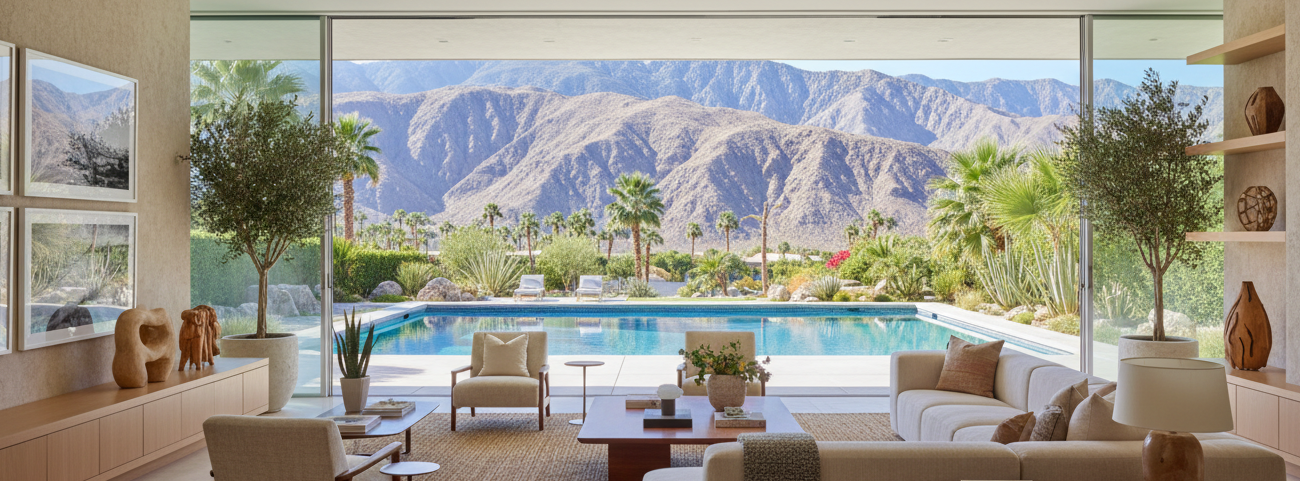
Once the mechanics are sound, we shift to aesthetics. Selling a luxury home in the desert is about selling a lifestyle. It is about capturing the specific allure of indoor-outdoor living that draws the world to our valley.

Luxury Staging: Curating the Desert Aesthetic

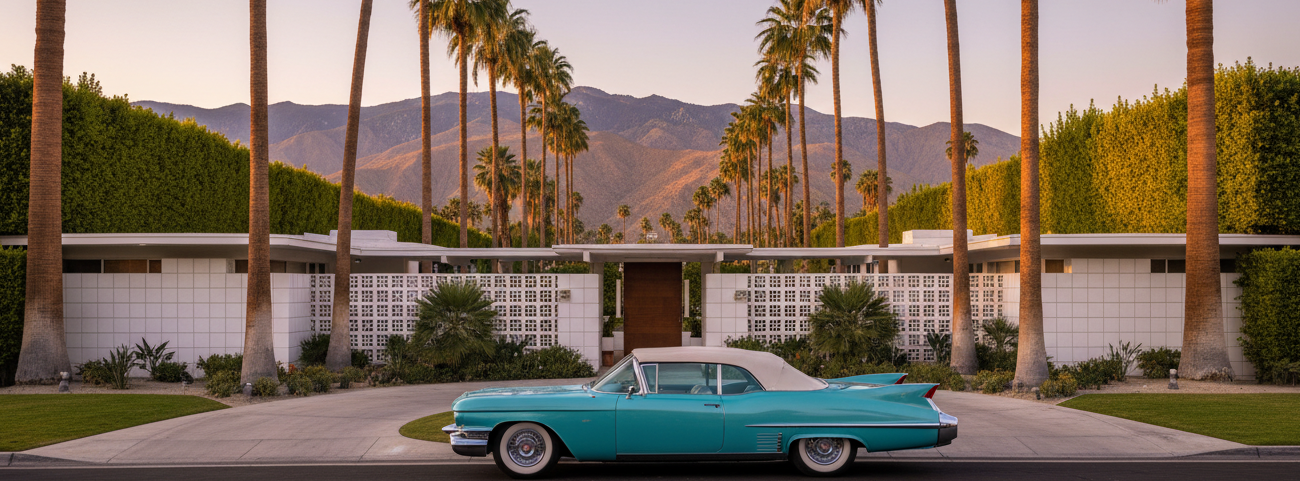
Staging is not just about furniture placement; it is about architectural interpretation. A mid-century modern home requires a different visual language than a Spanish estate in The Mesa.

We frequently see sellers rely on their own furniture. While your taste may be exquisite, personal items can distract. We need the buyer to envision their life in the space, not yours.

Effective staging in our market often involves:

  • Scale: Using substantial pieces that anchor large, open floor plans.
  • Palette: embracing organic textures and neutral tones that complement, rather than compete with, the desert views.
  • Flow: Arranging layouts that emphasize the seamless transition to the pool and outdoor entertainment areas.

We are selling the “Palm Springs chill.” If a room feels cluttered or confused, the buyer feels stress. We want them to feel relief.

Visual Storytelling

The first showing happens online. Period. If the digital presentation does not stop the scroll, the physical showing never happens.

Standard HDR photography is the bare minimum. For our elite listings, we employ a cinematic approach:

  • Twilight Photography: The “money shot” in the desert is often at dusk. We capture the property when the sky is a deep indigo, the pool lights are glowing, and the fire pit is roaring. This evokes an emotional response that daylight photos rarely achieve.
  • Drone Cinematography: We use aerial footage to show context. Buyers need to see the privacy of the lot, the proximity to the mountains, and the condition of the roof.
  • 3D Virtual Tours: International buyers may not be able to fly in immediately. A high-resolution Matterport tour allows them to walk the floor plan from London or New York.

We treat your property launch like a film premiere. Every asset must be perfect.

Phase 3: Targeted Marketing and Negotiation

You have a perfect product. Now, who needs to see it?

Global Exposure

Local MLS is insufficient for luxury assets. The buyer for your $4M estate might be in Los Angeles, but they are just as likely to be in Seattle, Toronto, or Berlin.

This is where the Engel & Völkers network becomes a tangible asset. We don’t just hope an international agent sees the listing; we actively syndicate your property to a global audience of high-net-worth individuals. We leverage our proprietary “Shop TV” in our storefronts worldwide and our exclusive publications.

We ensure your property appears where the wealth is. If we are selling a golf course estate in The Madison Club, we target specific demographics that value that privacy and exclusivity. It is surgical marketing, not a shotgun approach.

Negotiating Contingencies in a Buyer’s Market

When an offer comes in, the price is just one variable. In this market, terms matter immensely.

We are seeing buyers request extended contingencies, specific repairs, or financing pauses. As your representative, our job is to vet the buyer’s capability before we tie up your property.

  • Is the proof of funds current and liquid?
  • If there is a loan, is the lender reputable and responsive?
  • Are the contingencies reasonable for the age of the home?

We negotiate aggressively to tighten timelines. We want the buyer committed. If they want a 17-day inspection period, we push for 10. If they want a loan contingency, we ensure the appraisal is ordered immediately. We keep the momentum moving forward to ensure a successful close.

Structure Your Strategic Acquisition

Selling a luxury home in Palm Springs requires more than luck. It demands a deliberate, data-backed execution of the steps above. You need to prep the asset, price it with precision, present it beautifully, and market it globally.

If you are ready to discuss how we can position your property to outperform the market, let’s look at the numbers together.

Next Steps:

Contact us today to request a confidential, personalized Home Valuation and marketing consultation. Let’s maximize your return.

The Complete Financial Guide to Buying a Second Home in Palm Springs: Taxes, Financing, and Investment Strategy

The Complete Financial Guide to Buying a Second Home in Palm Springs: Taxes, Financing, and Investment Strategy

“Profit is made when you buy, not when you sell.”

This old real estate adage holds particularly true in the Coachella Valley. While the allure of Palm Springs lies in its architectural beauty and winter sun, the success of your purchase is determined by a rigorous understanding of the numbers before you sign the contract.

We often see a fundamental misunderstanding among buyers regarding the classification of their desert retreat. Is it a true second home? An investment property? Or a hybrid? The answer dictates everything from your interest rate to your tax bill.

This guide strips away the marketing fluff to expose the financial machinery behind owning a luxury desert residence.

Financing Your Desert Getaway

Cash offers are common in our market—often exceeding 40% of transactions in high-end communities like Rancho Mirage or Indian Wells. However, even high-net-worth clients frequently choose to finance to preserve liquidity for other ventures. If you plan to carry a mortgage, be prepared for a different set of rules than what you encountered with your primary residence.

Down Payment and Interest Rate Realities

Lenders view second homes as higher risk than primary residences. If financial hardship strikes, owners typically default on the vacation home first. Consequently, the days of 10% down payments for luxury second homes are largely behind us.

For a true “second home” (a property you occupy for part of the year and do not rent out full-time), most jumbo lenders now require a minimum of 20% to 25% down. If the purchase price exceeds $2 million, we often see requirements push to 30% or more depending on your debt-to-income ratio and liquidity.

Interest rates also carry a premium. You should anticipate a rate approximately 0.50% to 0.75% higher than current primary mortgage rates. This “pricing hit” is standard. If you intend to classify the property purely as an “investment” loan (relying on rental income to qualify), the rate premium can jump even higher, sometimes a full percentage point above standard rates, and down payment requirements often stiffen to 25-30% strictly.

Leveraging Home Equity (HELOCs) from a Primary Residence

A strategy we frequently recommend to cash-rich but liquidity-conscious buyers involves utilizing a Home Equity Line of Credit (HELOC) on their primary residence.

If you have significant equity in your main home, opening a HELOC allows you to make what appears to be a “cash offer” in the desert. You draw the funds to close the deal—strengthening your negotiating position against other buyers—and then have the flexibility to pay down the line at your own pace or refinance the desert property later when rates stabilize. This approach often bypasses the origination fees and slower underwriting timelines of a new jumbo mortgage on the purchase itself.

Tax Implications for Non-Primary Residents

The tax code favors the prepared. How you use your desert home determines whether it becomes a tax shelter or a tax burden.

Deductions for Second Homes (Mortgage Interest and Property Taxes)

If you treat the property strictly as a personal second residence (no renting), you can generally deduct mortgage interest on up to $750,000 of total mortgage debt (combined with your primary home).

However, many of our clients in California are already hitting the $10,000 cap on State and Local Tax (SALT) deductions. Since California property taxes are roughly 1.1% to 1.25% of the purchase price, a $2 million home in La Quinta generates an annual tax bill of roughly $24,000. Under current tax law, much of this may not be deductible if you have already maxed out your SALT limit with your primary residence.

Note: Always consult your CPA. We are real estate experts, not tax preparers.

The 14-Day Rule: Maximizing Personal Use vs. Rental Deductions

This is the most critical concept for owners who plan to dabble in vacation rentals. The IRS “Masters Rule” (Section 280A) creates a distinct line in the sand.

Scenario A: The Tax-Free Income Strategy

If you rent your home for 14 days or fewer per year, you do not have to report that income to the IRS. It is tax-free. You could rent your estate during Coachella or the BNP Paribas Open for $10,000 a night, pocket $140,000, and technically owe zero federal tax on that revenue. The trade-off? You cannot deduct any rental expenses (cleaning, management fees, maintenance).

Scenario B: The Rental Property Strategy

If you rent the home for 15 days or more, you must report all income. However, you can then deduct rental expenses (prorated based on the percentage of rental days vs. total days).

Here is the catch: If you personally use the home for more than 14 days per year (or 10% of total rental days, whichever is greater), the IRS classifies it as a “personal residence.” This limits your deductions strictly to rental income; you cannot claim a loss to offset other income.

To maximize tax benefits, many investors strictly limit their personal use to stay under that 14-day/10% threshold, allowing them to classify the property as a true business activity.

Annual Costs of Luxury Desert Ownership

The purchase price is just the entry fee. The operational costs in the desert are unique and can surprise the uninitiated.

HOA Fees, Utilities, and High-End Maintenance

HOA Fees: In communities like The Lakes or Ironwood, monthly dues can range from $900 to over $1,800. These often include cable, internet, trash, and immaculate grounds maintenance, but they are a fixed cost that never goes away. Conversely, fee-simple neighborhoods in South Palm Springs might have zero HOA, but you bear the full burden of landscaping and pool care.

Utilities: This is the shock factor. Summer air conditioning bills for a 3,000-square-foot home can easily run $600 to $900 per month in July and August. Solar is not just a “green” feature here; it is a financial necessity that adds tangible resale value.

Pool Heating: Everyone loves a heated pool in December, but gas heaters are thirsty. Heating a standard pool for a weekend can cost $300 to $500 in gas charges alone. We advise clients to install variable-speed pumps and high-efficiency heaters to mitigate this.

Insurance Requirements

Standard homeowners insurance covers fire and theft, but the desert has specific needs.

  1. Earthquake Insurance: This is almost always a separate policy. Premiums vary wildly based on the age of the home and proximity to fault lines, but deductibles are high (often 10-15% of replacement cost).
  2. Vacation Rental Riders: If you plan to Airbnb your property, your standard policy likely excludes commercial activity. You need a specialized “short-term rental” rider or a commercial policy. Operating without one exposes you to massive liability if a guest is injured.

Structure Your Strategic Acquisition

Buying a second home in the Coachella Valley is a significant financial move that requires a team of experts. You need a lender who understands the nuances of jumbo non-primary loans and a CPA who can navigate the 14-day rule to your advantage.

We work daily with a vetted network of local professionals who specialize in luxury desert portfolios.

Next Steps:

Do not guess at the numbers. Contact us today to review our list of preferred lenders and tax strategists, and let’s ensure your desert purchase is as financially sound as it is beautiful.

From Rat Pack to Today: The Enduring History and Modern Luxury of Old Las Palmas, Palm Springs

From Rat Pack to Today: The Enduring History and Modern Luxury of Old Las Palmas, Palm Springs

“If the walls could talk, the estates of Old Las Palmas would sing in the voice of Frank Sinatra and gossip in the whisper of Hedda Hopper.” In the high-stakes world of Coachella Valley real estate, few neighborhoods command the immediate reverence of Old Las Palmas. While other enclaves have their moments of trendiness, this grid of manicured streets between Palm Canyon Drive and the mountains remains the undisputed heavyweight champion of Palm Springs prestige. It is not merely a collection of homes; it is a living museum of Hollywood royalty. For the discerning buyer, Old Las Palmas offers something rarer than marble countertops or infinity pools: provenance. We know that in this market, history is an asset class of its own. When you acquire a property here, you are not just buying square footage. You are securing a chapter in the narrative of American glamour.

The Golden Age: Celebrity Residents and Architectural Legacy

In the 1950s, Palm Springs was the playground where the studio system went to unwind. Old Las Palmas was its VIP section. The neighborhood, roughly bounded by Alejo Road to the south and Stevens Road to the north, became the de facto dormitory for the world’s most famous faces. They came for the privacy. They stayed for the sunshine. They built estates that defined an era.

Key Figures and Their Houses

The roll call of past residents reads like the credits of a Golden Age blockbuster. Elizabeth Taylor and Mike Todd escaped here. Kirk Douglas held court in a tennis estate that became legendary for its gatherings. Liberace brought his signature flamboyance to the neighborhood, creating a residence as ornate and spectacular as his stage presence. Perhaps most famously, the “King of Cool” himself, Dean Martin, commissioned a home here. While Sinatra’s “Twin Palms” in the nearby Movie Colony often grabs headlines, Dean Martin’s Old Las Palmas retreat was the epitome of desert cool—low-slung, stylish, and built for entertaining. Today, this star power has not faded; it has merely changed hands. The estate once owned by Dinah Shore—a stunning architectural gem designed by Donald Wexler—is now the desert retreat of Leonardo DiCaprio. This seamless transition from the icons of yesterday to the titans of today underscores a critical market reality: Old Las Palmas does not depreciate in social currency.

The Architectural Evolution

The visual language of Old Las Palmas is distinct. Unlike neighborhoods defined by a single style, this area showcases the evolution of desert luxury. It began in the 1920s and 30s with Spanish Colonial Revival. You see this in the thick white stucco walls, red clay tile roofs, and heavy timber gates that guard sprawling haciendas. These homes were built to keep the heat out and the romance in. Then came the post-war boom. The aesthetic shifted. Architects like Donald Wexler, E. Stewart Williams, and Buff & Hensman introduced the clean lines of Mid-Century Modernism. They replaced small windows with walls of glass. They swapped tile roofs for flat planes that seemed to float against the San Jacinto mountains. The result is a streetscape of incredible diversity. A 1930s Spanish estate can sit comfortably next to a glass-and-steel modernist masterpiece. This variety protects property values. It ensures the neighborhood never feels cookie-cutter. Every gate opens to a unique world.


Why Old Las Palmas Remains Exclusive Today

History gets people to look, but lifestyle makes them buy. We often tell clients that Old Las Palmas commands a premium not just for who lived here, but for how you live here now. The fundamentals of the neighborhood are nearly impossible to replicate elsewhere in the valley.

Location and Walkability

In a region where driving is almost mandatory, Old Las Palmas offers a rare luxury: walkability. You are minutes from the Uptown Design District. The best coffee shops, the chicest boutiques, and the most celebrated restaurants on North Palm Canyon Drive are a short stroll away. Yet, once you retreat behind your hedges, the silence is absolute. You get the connectivity of an urban environment with the tranquility of a remote desert hideaway. This balance is the holy grail of Palm Springs real estate, and no other neighborhood strikes it quite like this one.

Lot Sizes and Mature Landscape

Land is the ultimate luxury. In newer developments, homes are often squeezed onto half-acre lots with minimal setbacks. Old Las Palmas is different. The estates here were plotted when land was abundant.

  1. Estate Lots: It is common to find properties ranging from half an acre to well over an acre.
  2. Privacy: Deep setbacks mean your home is not right on the street.
  3. The “Green Wall”: The landscaping is mature. We are talking about 80-year-old palm trees and ficus hedges that tower twenty feet high. You cannot buy that at a nursery. You have to wait decades for it.

This mature greenery creates a microclimate of shade and privacy that feels established and secure. When you swim in your pool, you are not visible to the neighbors. You are in your own private resort.


Investing in Legacy: Modernizing a Historic Home

Buying in Old Las Palmas often involves stewardship. Many of these homes are architecturally significant. The smartest money in the room knows that the goal is not to tear down, but to elevate. Navigating Permits and Historic Review Boards Because of its significance, Old Las Palmas has strict preservation guidelines. If you acquire a Class 1 Historic Site, you are buying a piece of protected history. This sounds daunting. It is actually an advantage. These regulations prevent your neighbor from building a monstrosity that blocks your mountain view. They ensure the character of the street remains intact. However, it does require a sophisticated approach to renovation. You need a team that understands the local Historic Site Preservation Board (HSPB). We guide our clients through this process regularly. We know which architects respect the pedigree of these homes and which contractors can deliver white-glove finishes that satisfy modern codes.

Maintaining Authenticity While

Integrating Modern Amenities The most successful renovations in Old Las Palmas follow a simple rule: Classic shell, modern engine.

  • The Shell: Keep the rooflines. Restore the original steel casement windows. Preserve the terrazzo floors if you can.
  • The Engine: Upgrade the HVAC. Install smart home technology. Modernize the plumbing. Open up the kitchen to the living space if the original floor plan is too compartmented.

Buyers today want the look of 1955 but the comfort of 2025. They want the Sinatra vibe, but they also want a Sub-Zero fridge and high-speed fiber internet. Properties that bridge this gap—respecting their roots while offering turnkey luxury—consistently set price records for the neighborhood.

Structure Your Strategic Acquisition

Old Las Palmas is not a volume market. Inventory is low. Turnover is rare. When a significant estate comes to market, it often trades quietly, sometimes before it even hits the MLS. If you are serious about securing a legacy property in Palm Springs’ most storied neighborhood, you need to be positioned correctly. You need access to off-market intelligence and a strategy that moves faster than the competition.

Ready to own a piece of history?

View exclusive listings in the Old Las Palmas neighborhood.

The 10 Most Exclusive Luxury Gated Communities in the Coachella Valley: A Comparative Ranking

The 10 Most Exclusive Luxury Gated Communities in the Coachella Valley: A Comparative Ranking

“Privacy is the ultimate luxury.” In the Coachella Valley, this isn’t just a saying; it’s the foundation of our real estate market.

When our clients approach Engel & Völkers looking for a desert estate, they rarely ask for just a “house.” They want a specific lifestyle. They want the heavy iron gates that swing open to reveal perfectly manicured fairways. They want the concierge who knows their drink order before they sit down. We understand this world because we live and work in it every day.

But not all gates are created equal.

We have ranked the top 10 gated communities in the valley based on exclusivity, amenities, and average price point. Whether you seek the ultra-private “billionaire’s row” or a vibrant, active club for your family, this list cuts through the noise to show you exactly where you belong.

The Ultra-Elite Tier (Rank 1-3)

These are the heavyweights. The membership rolls here read like a Who’s Who of global industry. If you value absolute discretion and amenities that rival the world’s finest resorts, start your search here.

1. The Madison Club (La Quinta)

The Vibe: Modern Opulence.

The Golf: Tom Fazio.

There is the Coachella Valley, and then there is The Madison Club. It sits at the top of our ranking for a reason. This isn’t just a country club; it is a sanctuary for those who require the highest level of security and service.

The discovery center here doesn’t just hand you a brochure. They hand you a lifestyle. We see buyers drawn here for the “comfort stations” on the golf course—essentially gourmet kitchens stocked with everything from wagyu sliders to tequila, free for members during their round. The homes are architectural marvels, often exceeding 10,000 square feet, blending seamless indoor-outdoor living with views that frankly, photos cannot do justice.

2. The Vintage Club (Indian Wells)

The Vibe: Timeless Prestige.

The Golf: Tom Fazio (Mountain & Desert Courses).

If The Madison Club is the new king, The Vintage Club is the established monarch. This community in Indian Wells has defined desert luxury for decades.

Privacy here is paramount. The club is nestled at the base of the mountain, creating a natural amphitheater of rock and green. When we tour clients through The Vintage, the first thing they notice is the service. It is impeccable. Invisible yet omnipresent. The 85,000-square-foot clubhouse was recently renovated, ensuring that while the history is deep, the amenities are cutting-edge. It’s quiet money. It’s old-school elegance.

3. Eldorado Country Club (Indian Wells)

The Vibe: Understated Power.

The Golf: Tom Fazio (Redesign).

Eldorado Country Club is where presidents play. It has a rich history dating back to 1957 and maintains a culture of intimacy that larger clubs cannot replicate. You won’t find flash here. You will find a deep sense of community among people who have nothing left to prove. The homes are often tucked away, revealing themselves only as you drive up the winding driveways. It is the definition of a hidden gem for the ultra-wealthy.

The Lifestyle-Focused Tier (Rank 4-7)

This tier offers an incredible balance. These communities are elite, certainly, but they often feature a more vibrant social scene, younger demographics, or architectural diversity that appeals to the modern buyer.

4. Bighorn Golf Club (Palm Desert)

The Vibe: Architectural Drama.

The Golf: Arthur Hills & Tom Fazio.

Bighorn Golf Club is a visual stunner. Located high above Palm Desert, the elevation gives you city light views that are unmatched.

What we love about Bighorn is the architecture. You aren’t limited to Spanish Colonial here. You will see sweeping, organic contemporary homes that look like they grew out of the rock face. The “Pour House” restaurant and the new clubhouse facilities are vibrant and social. It’s a place where people actually hang out. If you want a home that doubles as a piece of art, Bighorn is your canvas.

5. The Hideaway (La Quinta)

The Vibe: Young, Fun, Social.

The Golf: Clive Clark & Pete Dye.

The Hideaway changed the game in La Quinta. It brought a younger, cooler energy to the golf club scene. The bungalows are legendary, and the social calendar is packed.

We often recommend The Hideaway to clients who want the country club perks without the “stuffy” atmosphere. It’s widely known for its fun, relaxed environment where members linger long after the 18th hole. The homes are large, beautiful, and typically feature the classic Santa Barbara style that feels right at home in the desert sun.

6. Toscana Country Club (Indian Wells)

The Vibe: Italian Renaissance.

The Golf: Jack Nicklaus (South & North).

Walking into Toscana Country Club feels like stepping into a European village. The olive trees, the stone work, the fountains—it is incredibly transportive.

We appreciate Toscana for its “lock-and-leave” convenience combined with estate-level luxury. The sports club here is fantastic, with a massive focus on wellness, tennis, and pickleball. It fits the active buyer perfectly.

7. Rancho La Quinta

The Vibe: Active Family Resort.

The Golf: Robert Trent Jones Jr. & Jerry Pate.

Rancho La Quinta is the sweet spot for many of our clients. It offers a prestigious address and fantastic golf, but at a price point that allows for a second or third home without the stratospheric initiation fees of the top three.

The architecture here is distinct—think Early California with deep loggias and red tiles. It is incredibly friendly. You see families biking, neighbors walking dogs, and a general buzz of activity. It’s luxurious, but it’s also livable.

The Establishment (Rank 8-10)

These clubs are the backbone of the valley’s luxury market. They offer history, solid value, and classic desert living.

8. Thunderbird Country Club (Rancho Mirage)

Thunderbird Country Club is where it all began. The history here is palpable. If you love Mid-Century Modern architecture and a club with stories to tell, this is it.

9. Indian Wells Country Club

Known for the “Fun Club” reputation, Indian Wells Country Club offers 36 holes of golf and a massive clubhouse that serves as the social hub of the city.

10. Mountain View Country Club (La Quinta)

Adjacent to The Hideaway, Mountain View offers magnificent views and an Arnold Palmer signature course. It is an exceptional value for the quality of the homes and the club experience.

Security and Access: The Gated Difference

Why do our clients insist on these specific names? It comes down to two factors.

Discretion and Privacy for High-Profile Residents

In an open neighborhood, anyone can drive down your street. In communities like The Madison or The Vintage, access is strictly controlled. Security teams are often staffed by former law enforcement. They know the residents. They know the vehicles. For high-net-worth individuals, this peace of mind is priceless. You can walk your dog at midnight or leave your car unlocked in the driveway without a second thought.

HOA Fees and What They Cover

Yes, the monthly dues can be significant. But you must look at what you get.

  • Concierge Services: From restaurant reservations to home maintenance coordination.
  • Wellness: State-of-the-art gyms that replace the need for a personal trainer membership.
  • Maintenance: Common areas are manicured to perfection, protecting your property value.

When you buy into these HOAs, you are buying into a corporation dedicated to maintaining your asset’s value and your personal comfort.

Structure Your Strategic Acquisition

Reading about these communities is one thing. Walking the fairways and standing in the great rooms is another.

The market in these top-tier enclaves moves fast. Off-market “pocket listings” are common, and often the best homes are sold before they ever hit the MLS. You need a partner who knows the gate codes and the membership directors.

I can arrange private tours of these discreet communities, often getting you access to homes that aren’t publicly listed.

Would you like me to schedule a private tour of a gated community for you this week?

Contact Us to Schedule Your Tour

The Battle of the Eras: Mid-Century Modern vs. New Luxury Construction in Palm Springs—A Value Analysis

The Battle of the Eras: Mid-Century Modern vs. New Luxury Construction in Palm Springs—A Value Analysis

“I want a house where I can look out and see the mountains, but I don’t want the mountains to see me.”

When Frank Sinatra gave that directive to architect E. Stewart Williams in 1947, he wasn’t just commissioning a home; he was inadvertently drafting the constitution for Palm Springs luxury real estate. Seventy-five years later, the market remains locked in a fascinating duel. On one side, the architectural purists chasing the provenance of a Wexler or a Frey. On the other, the pragmatists demanding the net-zero efficiency of a 2024 custom build.

We see this tension daily at Engel & Völkers.

The question isn’t just about aesthetics. It is a question of asset performance. Which holds better value? The restored 1958 butterfly roof that requires specialized insurance, or the brand-new concrete-and-glass fortress that runs its climate control off a smartphone?

This is a comparative value analysis of the two dominant asset classes in the Coachella Valley.

Mid-Century Modern (MCM) Homes: Investment Value and Challenges

To own a Mid-Century Modern home in Palm Springs is to act as a custodian of history. You are not merely buying square footage; you are acquiring a piece of habitable art. However, the valuation metrics for these properties differ wildly from standard real estate appraisal.

Appreciation & Historical Significance

In neighborhoods like Twin Palms, the value is derived less from the utility of the shelter and more from the pedigree of the design. We have seen specific homes—Alexander Construction Company originals, specifically—outperform the broader market by significant margins during correction cycles. Why? Scarcity.

They simply aren’t building any more 1959 Palmers.

When a property has a documented lineage—perhaps a confirmed design by Donald Wexler or William Krisel—it enters a collector’s market similar to fine art. Appreciation here is non-linear. A restored home in Vista Las Palmas can command a price per square foot that defies the logic of replacement cost. The buyer is paying for the “preservation premium.”

This premium is resilient. While new builds compete with other new builds, a pristine MCM home competes with nothing but history.

The Maintenance vs. Preservation Debate

Here is the reality that glossy magazines ignore: 1950s infrastructure was not designed for 2020s living.

I often advise clients that purchasing an unrenovated MCM gem is akin to buying a vintage Jaguar. It is beautiful, it turns heads, and it will require a mechanic on speed dial. The challenge lies in modernizing the systems without destroying the soul of the structure.

  • Glazing: The original single-pane glass walls are iconic but thermally disastrous. Replacing them with dual-pane, low-emissivity glass that matches the original aluminum frames is a six-figure capital expenditure.
  • Insulation: Many post-and-beam roofs have zero cavity for insulation. Climate control becomes a battle against the desert sun.
  • Systems: We frequently encounter cast-iron plumbing nearing the end of its life and electrical panels unable to handle the load of modern EV chargers.

The “Value Trap” here is over-renovation. Replacing the original terrazzo with generic porcelain tile may lower your maintenance, but it will instantaneously decapitate the asset’s resale value. The smartest money we see goes into invisible upgrades: new roofs, updated electrical, and sewer relining, leaving the visible vintage aesthetics strictly alone.

New Construction Luxury: Amenities and Efficiency

Shift your gaze to the new custom estates rising in the Mesa or the Movie Colony. These homes are engineered machines designed for effortless ownership. For the buyer who views their Palm Springs residence as a retreat rather than a project, new construction offers a compelling mathematical argument.

Smart Home Integration and Energy Efficiency

California’s Title 24 energy standards are some of the strictest in the world. A home built in 2024 is effectively a sealed envelope.

  • Thermal Mass: New builds utilize 2×6 framing or concrete forms, offering insulation values that a 1950s build could never achieve.
  • Automation: We are seeing full integration where shades, pool temperatures, security, and lighting are managed remotely. You can cool the house down from your jet before you land at PSP.
  • Sustainability: Solar integration is now standard, often coupled with battery storage.

The operational cost of a 4,000-square-foot new construction home can be 60% lower than a similarly sized unrenovated vintage property. Over a ten-year hold period, this operational delta adds up to a significant sum.

Pricing and Customization in New Developments

The premium here is for customization. New luxury inventory allows the buyer to dictate the floor plan. The trend is moving toward “invisible luxury”—amenities that are felt but not seen. Acoustic soundproofing between rooms. Hospital-grade air filtration systems. Integrated wellness spaces.

However, the acquisition cost is high. Construction costs in the Coachella Valley have surged. You are paying for the certainty of “new.” The risk profile is lower—you won’t find asbestos in the walls or galvanized pipes under the slab—but the entry price reflects that safety. Unlike the MCM market, where sweat equity can force appreciation, new construction value is tied more closely to the broader market data.

The Buyer Profile: Which Home is Right for You?

Choosing between these two paths requires an honest assessment of your lifestyle and your patience.

The Collector vs. The Turnkey Executive

The Collector is willing to sacrifice some thermal comfort for the lines of a roof. They understand that they might hear their neighbor’s pool pump because the walls are thin. They don’t care. They want the terrazzo. They want the breeze block. They are buying a legacy. If this is you, stick to the historic districts. The appreciation potential is higher if you buy the right architectural pedigree.

The Turnkey Executive wants to arrive on Friday night, drop their bags, and relax. They do not want to meet a contractor on Saturday morning to discuss dry rot. They prioritize high ceilings, massive closets (rare in MCM homes), and garage space for three cars. For this buyer, a new build or a “down-to-the-studs” modern renovation is the only logical choice.

The Role of Outdoor Architecture

The philosophy of the grounds has shifted.

In the mid-century era, the focus was often on the lawn—a green carpet juxtaposed against the stark desert. Today, the conversation is about water stewardship and “sculptural arid” design.

New luxury homes are embracing the native environment. We see old-growth olive trees, massive boulders, and fire features that mimic the natural geology. This “Xeriscaping” is no longer just a cost-saving measure; it is a high-design aesthetic.

An MCM home often requires a reimagining of the grounds to meet modern standards. A new build comes with this baked into the design. The difference in water bills alone can be shocking.

Structure Your Strategic Acquisition

There is no “wrong” choice, only a choice that is misaligned with your goals.

If you buy a Wexler, you are an art collector. If you buy a 2025 custom build, you are a lifestyle investor. Both can yield tremendous returns, but they require different acquisition strategies and different exit plans.

The market in Palm Springs is micro-segmented. A block can make a million-dollar difference. You need an advisor who knows not just the price per square foot, but the history of the builder and the future of the neighborhood.

Would you like me to curate a side-by-side tour of a pristine Alexander mid-century home and a newly completed custom estate so you can feel the difference in person?

Contact Engel & Völkers Palm Springs

The Foreign National’s Handbook: A Guide to Buying Luxury Real Estate in the Coachella Valley (Canadian & Overseas Buyers)

The Foreign National's Handbook: A Guide to Buying Luxury Real Estate in the Coachella Valley (Canadian & Overseas Buyers)

57% of Canadian buyers in the US pay all cash. That is a staggering statistic from recent market data. It signals two things: significant capital strength and a strong desire to secure a “sunshine getaway” without the strings of financing.

But here is the reality for the other 43%—and for every foreign investor looking at the Coachella Valley: buying property in the United States is deceptively easy. Structuring that acquisition to protect your wealth, however, requires a different level of expertise.

You are not just buying a vacation home in Palm Springs or Indian Wells; you are entering a new tax jurisdiction, a distinct legal environment, and a foreign banking system. Navigating this alone is a mistake. As a global brokerage, Engel & Völkers specializes in guiding international clients—particularly our Canadian neighbors—through these precise challenges.

The Legal and Tax Environment

The United States encourages foreign investment, but the IRS (Internal Revenue Service) ensures they capture their share of the gains. You must understand the rules of engagement before you sign a purchase agreement.

Understanding FIRPTA: What Foreign Sellers Need to Know

This is the single most common stumbling block for international buyers. The Foreign Investment in Real Property Tax Act (FIRPTA) is a withholding tax, not an additional tax.

Here is how it works: When a foreign national sells a US property, the IRS wants to guarantee they file a tax return to report the capital gain. To ensure this happens, the US government effectively deputizes the buyer to withhold 15% of the gross sales price at closing and send it directly to the IRS.

Why this matters to you as a buyer:

If you eventually sell your Rancho Mirage estate, 15% of your equity will be tied up with the IRS until you file your US tax return. It is a cash flow consideration you must plan for.

  • The Exception: If the property is under $300,000 and the buyer signs an affidavit of residency (intending to live there), the withholding may be waived. However, in the luxury market—where we are dealing with estates in The Vintage Club or Bighorn—this exception rarely applies.

Acquisition Structures: Individual vs. LLC

Many of our Canadian clients ask, “Should I buy this in my own name or a US corporation?”

Buying as an Individual:

  • Pros: Simpler. Lower setup costs. Favorable capital gains treatment upon sale.
  • Cons: Unlimited liability. Your name appears on public deed records (less privacy).
Buying via a US LLC (Limited Liability Company):
  • Pros: High privacy. Liability protection (if someone slips by the pool, your other assets are shielded). Seamless transfer of ownership to heirs in some cases.
  • Cons: Higher annual maintenance costs ($800/year minimum in California). US tax returns must be filed for the entity.

Note: We are real estate experts, not tax attorneys. We strongly recommend you speak with a cross-border tax specialist to determine which structure suits your portfolio.

Financing for Non-US Residents

If you choose not to liquidate cash assets, US financing is available. It is often called a “Foreign National Loan.”

Requirements and Documents

US lenders cannot track your credit score via Equifax Canada or TransUnion abroad in the same way they do for domestic borrowers. Therefore, they mitigate their risk by requiring “skin in the game.”

  • Down Payment: Expect to put down 30% to 50%.
  • Reserves: You may need to show 6–12 months of mortgage payments in liquid cash reserves in a US bank account.
  • Credit References: Instead of a credit score, lenders often ask for letters of good standing from your home bank, credit card companies, or landlord.

We work with specific lenders in the desert who understand the international borrower profile and can close these loans efficiently.

Contact us for a direct introduction to these specialists.

Currency Fluctuations and Hedging Strategies

The exchange rate can make a $2 million home cost you 10% more—or less—depending on when you transfer your funds.

Smart buyers do not just watch the spot rate. They use currency brokers to “lock in” a rate once they enter escrow. If the Canadian Dollar or Euro weakens against the USD during your 30-day escrow period, your purchase price effectively increases. Hedging protects your buying power.

The Purchase Process, Simplified

The mechanics of buying here differ from the UK, Canada, or Europe. We use a “neutral third party” system that minimizes risk for both sides.

Escrow, Title Insurance, and Due Diligence

In many countries, lawyers handle the money and the transfer of deeds. In California, we use Escrow.

  1. Escrow: An independent company holds your deposit. They do not release funds to the seller until every condition of the contract is met. You are protected.
  2. Title Insurance: In the US, you receive an insurance policy that guarantees you own the property free and clear of past liens (unpaid contractor bills, old tax debts). This is mandatory for your protection.
  3. Due Diligence Period: You typically have 17 days after acceptance to inspect the property. You will hire a general home inspector, but for luxury estates, we also recommend specialists: pool inspectors, roof inspectors, and sewer scope technicians. If you find a defect, you can request repairs or cancel the contract and get your full deposit back.

Property Management Solutions for Absentee Owners

Your time in the Coachella Valley should be about golf, tennis, and relaxation—not managing pool maintenance from 3,000 miles away.

For our clients who spend only part of the year here, we recommend “Estate Managers” or “Home Watch” services. These are not rental managers; they are professionals who check your property weekly. They flush toilets, run faucets, check for landscape leaks, and ensure your vendor teams (pool, gardener, pest control) are doing their jobs.

This ensures that when you arrive for the season, your home is pristine.

Structure Your Strategic Acquisition

The Coachella Valley is a global destination. Whether you are eyeing a mid-century modern gem in Palm Springs or a gated compound in La Quinta, the lifestyle return on investment is undeniable. The financial return depends on how smart you buy.

Engel & Völkers is the only true global brokerage in the desert. We speak the language of international luxury because we operate in over 30 countries. We connect you not just to a home, but to the legal, financial, and management resources you need to own it with confidence.

Next Steps:

Do not leave your cross-border purchase to chance. We have prepared a detailed checklist specifically for our Canadian and overseas clients to ensure no detail is missed.

Contact us today to receive your “Foreign National Buyer’s Checklist” and start your search.

The Ultimate Guide to Desert Landscaping & Water Conservation for Luxury Estates in Palm Springs

The Ultimate Guide to Desert Landscaping & Water Conservation for Luxury Estates in Palm Springs

“The desert, when the sun comes up… I couldn’t tell where heaven stopped and the Earth began.” – Tom Hanks.

There is a distinct magic to the Coachella Valley. But for the new owner of a luxury estate, that magic comes with a very practical price tag: water.

Gone are the days when a sign of wealth was a sprawling, emerald-green lawn indistinguishable from a Connecticut suburb. Today, the true mark of sophistication in the desert is a property that harmonizes with its environment rather than fighting it. We find that our most discerning clients now demand outdoor spaces that are both breathtakingly beautiful and responsibly sustainable. They want the “Palm Springs aesthetic”—architectural plants, dramatic lighting, and smart water usage.

If you are acquiring a high-value property, you need to understand the economics and aesthetics of the grounds you are buying.

Designing the Desert Oasis (Aesthetics)

The shift in high-end exterior design has moved toward “Desert Modern.” This style treats outdoor spaces as living art galleries, focusing on structure, silhouette, and shadow play against the stark mountain backdrops of neighborhoods like Rancho Mirage.

Succulent Gardens and Xeriscaping: Beauty without Waste

Xeriscaping often gets a bad reputation. People hear the word and imagine a barren lot filled with gravel and a single, sad cactus. That is not what we are talking about.

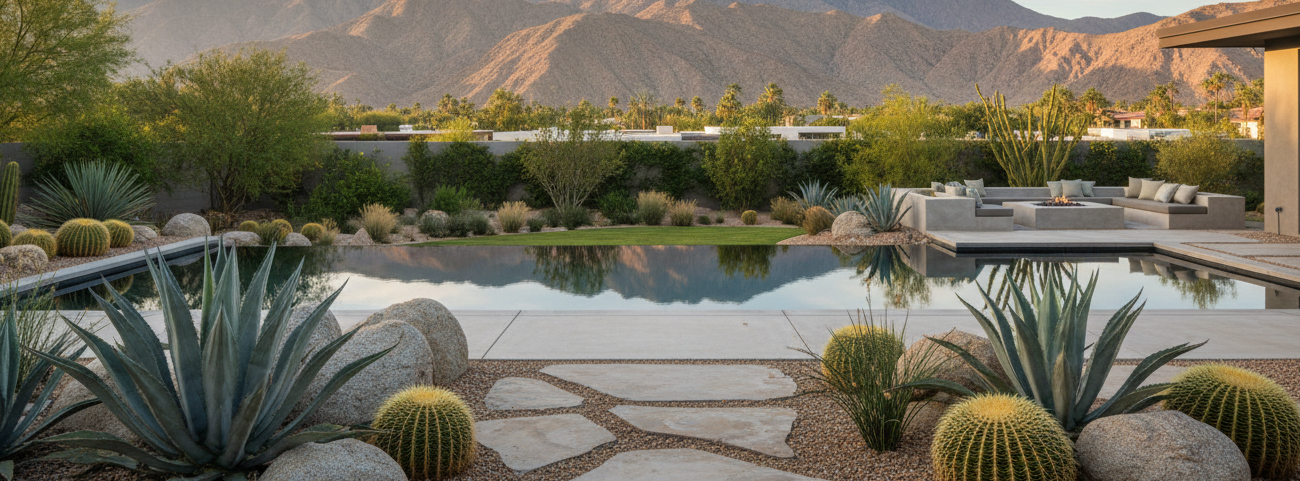
High-end Xeriscaping Palm Springs style is lush, colorful, and vibrant. It relies on drought-tolerant plants that thrive in our intense heat. We recommend incorporating architectural heavyweights like the Agave Americana (Century Plant) for its massive, blue-grey sculptural leaves, or the Ocotillo, which produces striking crimson flowers.

The key is density and layering. By grouping plants with similar water needs (hydro-zoning), you create visual pockets of lushness without wasting hydration on the entire property. Ground cover is equally critical. Instead of thirsty grass, luxury estates now utilize decomposed granite (DG) in various earth tones, crushed basalt, or river rock to create texture and reduce dust. This approach doesn’t just save water; it drastically reduces the weekly noise of lawnmowers, preserving the tranquility of your estate.

Integrating Water Features and Ponds (Smart Design)

You do not have to abandon water entirely. The sound of trickling water is a cooling psychological trigger that enhances the feeling of an oasis. However, the design must be intentional.

Massive spray fountains are inefficient; the water evaporates before it hits the basin. Instead, we see a trend toward “negative edge” reflecting pools and architectural troughs. These features have a smaller surface area relative to their volume, reducing evaporation rates while providing that essential mirrored surface that looks so spectacular at sunset.

If you are looking at properties in Indian Wells, notice how the premier estates utilize water as a focal point—a singular, sleek trough fountain near the entryway—rather than a sprawling, thirsty lake.

Water Conservation Technology for Large Estates

Managing a half-acre or more in the desert requires automation. You cannot rely on a simple timer and a gardener with a hose.

Smart Irrigation Systems and Drip Technology

For Water-Wise Landscaping Luxury Desert Homes, the irrigation controller is the brain of the operation. We always advise our clients to upgrade immediately to smart controllers like Rachio or Hunter Hydrawise.

These systems connect to local weather stations via Wi-Fi. If rain is forecast (rare, but it happens) or if the wind creates high evaporation rates, the system adjusts automatically. It stops the sprinklers from running during a windstorm, which prevents water from simply blowing onto your driveway.

Furthermore, subsurface drip irrigation is non-negotiable for vegetation. Unlike spray heads that mist the air, drip lines deliver water directly to the root zones. This eliminates runoff and ensures that 100% of the water you pay for is actually used by the plants.

Turf Alternatives and Artificial Grass Solutions (Pros and Cons)

Let’s address the elephant in the room: artificial turf. Ten years ago, it looked like plastic carpet. Today, the technology is unrecognizable.

Modern high-end synthetic turf features multi-colored blades (thatch) to mimic the imperfections of real grass. It has “memory” fibers that stand up to foot traffic. For a luxury estate, it offers a permanent, manicured look that real grass can only achieve for about four months of the year here.

The Pros:
  • Zero water usage.
  • Always green, even in the blistering August heat.
  • No fertilizers or pesticides entering the groundwater.
The Cons:
  • Heat retention: Synthetic turf can get incredibly hot in direct summer sun, making it unusable for pets or bare feet in the afternoon without a quick spray down.
  • Initial Cost: It is an investment. Expect to pay between $10 to $15 per square foot for top-tier installation.

For families with pets or children, we often suggest a hybrid approach: a small area of real sod for play, surrounded by high-quality synthetic turf and native gardens for the visual expanse.

Maintenance and Cost Considerations

Owning a desert estate is different from owning a home in the Pacific Northwest or the East Coast. The enemies here are not moss and dampness; they are sun, wind, and dry rot.

Finding Specialized Desert Landscape Teams

Your standard “mow and blow” crew is not qualified to maintain a high-value succulent garden. Pruning an agave or a palo verde tree requires specific knowledge. If you prune them at the wrong time of year, the bark can sunburn, killing the tree.

I always tell my clients: hire a team that includes a certified arborist. They will know how to inspect your irrigation drip lines for leaks (which coyotes often chew on) and how to fertilize citrus trees properly. A specialized team might cost 20-30% more monthly, but they will save you thousands in replacement costs for specimen plants that die due to mismanagement.

Estimated Annual Water and Maintenance Budgets

Understanding Desert Landscaping Maintenance Costs is vital for your ROI.

  • Water: A traditional grass-heavy estate can easily rack up water bills exceeding $800 to $1,500 per month in the summer. By converting to a xeriscape-heavy design, we have seen clients drop that bill to the $200-$300 range.
  • Labor: While you save on weekly mowing, desert gardens still need care. Expect to pay a monthly retainer of $300-$600 for a standard lot, and upwards of $1,000+ for estate-sized grounds. However, this cost is stable. You won’t be paying for “seasonal color change-outs” or massive reseeding projects every winter (over-seeding rye grass), which can cost $3,000+ annually for large lawns.

Structure Your Strategic Acquisition

The exterior of your home is the first thing you see and the last thing you experience before you leave. In the Coachella Valley, it dictates your lifestyle. A well-designed, water-efficient property is not just an environmental choice; it is a financial asset that lowers holding costs and increases resale desirability.

We know the specific micro-climates of every neighborhood. We know where the wind hits hardest in North Palm Springs and which pockets of Rancho Mirage offer the best soil for citrus groves.

If you are ready to view estates that master the balance of luxury and sustainability, or if you need a referral for a top-tier local arborist to inspect a potential purchase, let’s connect.

Contact us today to discuss your specific requirements.