
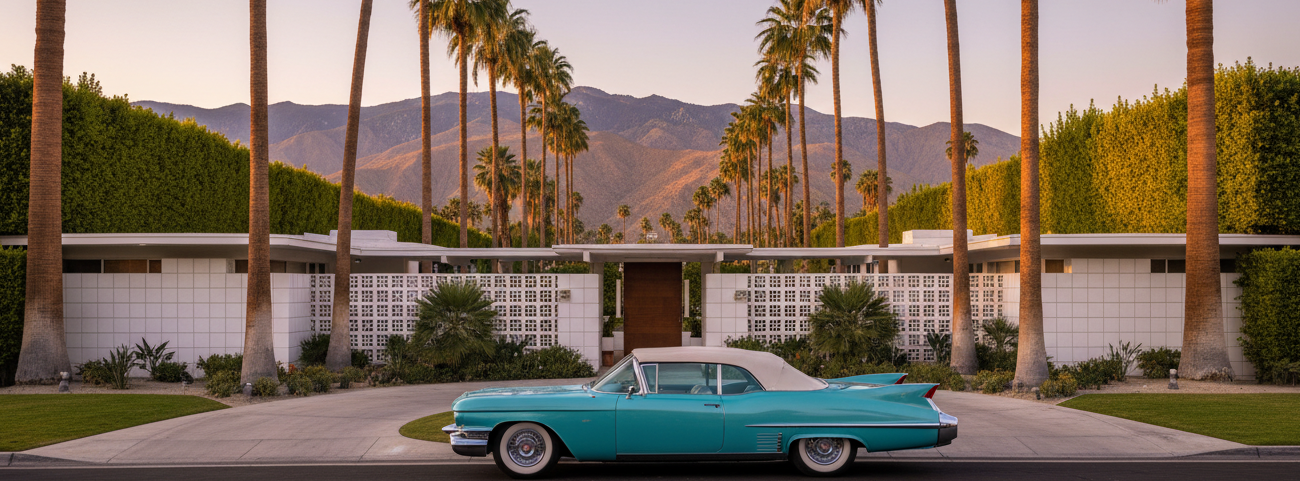
The Collector's Guide: Investing in Architectural History During Palm Springs Modernism Week
“Architecture should speak of its time and place, but yearn for timelessness.” — Frank Gehry.
In the Coachella Valley, this sentiment is not just philosophy; it is a tangible asset class. As Palm Springs Modernism Week approaches, the eyes of the global design community turn toward our desert enclave. Yet, for the astute investor and the architectural connoisseur, this event signifies more than just open houses and cocktail parties. It represents a prime window to evaluate Palm Springs Modernism Week Real Estate not merely as housing, but as collectible art.
At Engel & Völkers, we see a shift in how high-net-worth individuals approach these properties. We are no longer just selling square footage. We are transferring stewardship of history. When you acquire a Wexler or a Neutra, you secure a position in a finite legacy. This guide details how to navigate the market for Mid-Century Modern Homes for Sale Palm Springs with the precision of a curator.
The MCM Investment Rationale
A Basquiat canvas does not fluctuate based on the price of paint. Similarly, true architectural homes in Palm Springs have decoupled from standard market comparables. They operate on a different valuation tier driven by provenance, pedigree, and integrity.
We advise our clients to view these structures through the lens of scarcity. There is a finite supply of homes authored by the mid-century masters. Unlike contemporary builds, we cannot simply construct more 1958 Alexander Originals. This fixed supply, paired with a global demand that accelerates during Modernism Week, creates a powerful value proposition for the educated buyer.
Key Architectural Signatures
To invest wisely, you must identify the hands that shaped the desert. While many homes bear the “mid-century” label, Collecting Architectural Homes requires distinguishing between a generic renovation and a masterwork. We focus our acquisition strategies on the “Holy Trinity” of desert modernism:- Richard Neutra: Look for the dissolution of indoor-outdoor boundaries. His “spider leg” outriggers and silver-painted window frames are not just stylistic choices; they are trademarks of a philosophy that integrated the stark desert environment with domestic life.
- Donald Wexler: A pioneer of steel construction. A Wexler steel home is the ultimate prize for many collectors due to its rarity and structural resilience. The clean lines and folded plate roofs are unmistakable.
- E. Stewart Williams: He brought a warmth to modernism, often utilizing natural materials like wood and stone to anchor the home to the site. His structures feel grown from the desert floor rather than placed upon it.
The Scarcity Principle
The market rewards purity. A property that retains its original footprint, post-and-beam construction, and clerestory windows commands a premium over one that has been aggressively altered.
We often see a sharp divide in valuation between “restored” and “preserved” homes. A restored home returns a modified structure to its original glory, often requiring significant capital but resulting in a high-value asset. A preserved home, however, is a time capsule—a structure that has never been compromised. These uncompromised originals are the unicorns of the market. They are incredibly rare and offer the highest potential for appreciation because they offer an authentic narrative that cannot be replicated.
Where to Find the Best MCM Homes Today
During Modernism Week, inventory moves quickly. Knowing where to look is half the battle. We direct our clients to specific enclaves where architectural integrity remains protected and celebrated.
Vista Las Palmas
If you seek the “Beverly Hills of Palm Springs,” this is your destination. Historically home to the Hollywood elite—from Marilyn Monroe to Dean Martin—Vista Las Palmas offers some of the most dramatic rooflines in the valley. The neighborhood is defined by its wide streets and the high concentration of Alexander Construction Company homes designed by Palmer & Krisel.
Here, the quintessential “butterfly roof” is more than a design element; it is a status symbol. The appreciation in this neighborhood has been consistent, driven by the sheer density of Class 1 Historic Sites. When we list a property here, we are marketing a lifestyle of uncompromising luxury.
- Explore listings in this area: View Palm Springs Properties
Sunmor and Racquet Club Estates
For the collector who values the specific aesthetic of the Alexander and Meiselman homes, these neighborhoods are ground zero.
Sunmor is a hidden gem. It sits centrally located yet maintains a serene, wind-free atmosphere that is rare in the valley. The homes here often feature the distinct breeze-block walls and breezeways that define the era. It is an area where we see tremendous upside potential for buyers willing to perform sensitive restorations.
- Discover the neighborhood: Sunmor Real Estate
Racquet Club Estates, famously associated with the Racquet Club resort, offers the classic post-and-beam construction that purists adore. These homes were originally built as vacation getaways, meaning they were designed for leisure and flow. Today, they stand as perfect entry points for serious collectors starting their portfolio.
- Browse current inventory: Racquet Club Estates & Vista Norte
The Due Diligence of a Collector’s Property
Acquiring a vintage home differs vastly from buying new construction. The very features that drive value—original materials, flat roofs, single-pane glass—also present unique ownership challenges. We guide our clients through a rigorous due diligence process to ensure the asset is sound.
Navigating Historic District Regulations
Owning a piece of history comes with responsibility. Many of the most desirable MCM homes fall under Historic District designations or carry a Class 1 Historic Site status.
This is a double-edged sword. On one side, it guarantees that your neighbors cannot demolish their homes to build McMansions, protecting your property value. On the other, it restricts what you can do to the exterior of your own home. You cannot simply replace windows or change paint colors without approval. We help you navigate the Mills Act—a critical tax incentive that offers significant property tax reductions in exchange for preserving the home’s historical appearance. It is a powerful tool for ROI, but it requires expert navigation.
Assessing Original Systems
Authenticity is beautiful, but 1950s infrastructure is not. When we evaluate a “preserved” home, we look past the terrazzo floors and globe pendant lights to the bones of the structure.
- Plumbing: Many original homes still have galvanized steel pipes, which have a finite lifespan. We check for proactive repiping.
- Electrical: The original panels were not designed for modern load demands—EV chargers, smart home systems, and high-efficiency HVAC. A 200-amp panel upgrade is often a necessary capital improvement.
- Insulation: The iconic flat roofs often lack insulation, making the home energy-inefficient. We identify properties where modern foam roofing systems have been applied to improve efficiency without ruining the architectural profile.
Structure Your Strategic Acquisition
Modernism Week is not just a celebration; it is a catalyst for the real estate market. The most desirable properties often transact quietly, sometimes before they ever reach the public MLS.
If you are serious about securing a piece of Palm Springs history, do not wait for the open houses. We have access to off-market architectural properties and can arrange private viewings tailored to your specific acquisition criteria.
Ready to curate your collection?
Contact us today to request a private portfolio of architecturally significant homes currently available for purchase.